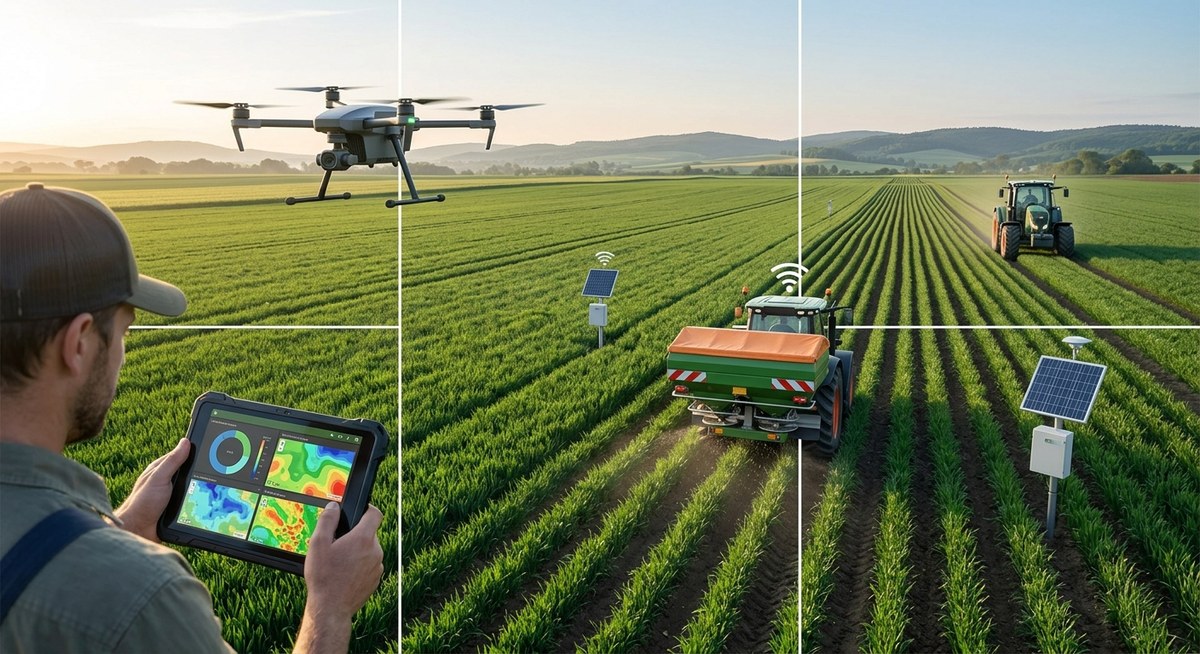
Every season brings the same challenge. Input costs rise while margins get tighter. Seed, fertilizer, fuel, water. The list goes on. You cannot control commodity prices or weather patterns. But you can control how efficiently you use your inputs. That is where smart farming tools come into the picture. In 2026, technology is not just for early adopters anymore. It is a practical way to trim your biggest expenses without cutting corners on yield. The best part? Many of these tools start paying for themselves within a single growing season.
Input costs keep climbing, but smart farming tools help you push back. In 2026, the right technology means applying seed, fertilizer, water, and fuel only where they are needed most. This guide covers five tools that deliver measurable savings, from variable rate technology to drone scouting. Each one pays for itself when input prices are tight. The goal is simple: grow more with less. These tools help you make decisions based on data, not guesswork. Start small, see the savings, and scale up from there.
Why Input Costs Demand Smarter Decisions This Year
Farming has always been a margin business. But 2026 is shaping up to be a year where every dollar counts. Fertilizer prices remain volatile. Fuel costs bounce up and down. Seed prices keep trending higher. Traditional blanket application methods waste a surprising amount of these inputs. Think about it. Spreading the same rate of fertilizer across an entire field ignores the fact that some areas need more and some need less. The same goes for water, seed, and pest control.
Smart farming tools solve this mismatch. They give you field level data that tells you exactly where each input should go. Instead of treating your whole farm as one average unit, you start managing it as a collection of unique zones. That shift alone can cut input costs by 10 to 20 percent in the first year. And the technology keeps getting more affordable.
If you are new to this space, start by looking at how harnessing IoT devices to transform modern farming practices can give you real time visibility into what is happening in your fields. That visibility is the foundation for every other decision.
Tool #1: Variable Rate Technology for Seed and Fertilizer
Variable rate technology, or VRT, is one of the most direct ways to cut input costs. Instead of applying a single rate across the whole field, VRT lets you change the rate as you move through different soil types and productivity zones.
How VRT Saves You Money
- Reduces seed waste in low productivity areas
- Puts fertilizer only where it will return value
- Lowers overall nitrogen use without hurting yield
- Creates as applied maps that help you plan next season
The setup is straightforward. You need a soil map, a compatible planter or spreader, and a simple controller in the cab. Many newer tractors and implements come with VRT capability built in. If yours does not, aftermarket kits are available and prices have dropped significantly in the last two years.
Pairing VRT with soil sensor data makes the system even more effective. When you know the exact nutrient levels in each zone, you can fine tune your application rates with confidence. Check out this guide on implementing digital soil sensors to boost crop health and productivity to see how the two technologies work together.
Tool #2: Soil Sensors That End the Guesswork
Soil moisture and nutrient sensors have become much more reliable and affordable. In 2026, a solid sensor network for a 100 acre field costs less than a single tank of diesel for a harvest season. And the data they provide can save you many times that amount.
What Soil Sensors Tell You
- Exactly when to irrigate and when to wait
- Nitrogen levels in real time, so you only apply what is missing
- Temperature trends that affect planting timing
- Salinity issues before they hurt your crop
The biggest mistake farmers make with soil sensors is placing them in only one spot. A single sensor cannot represent your whole field. Place them in at least three to five locations that match your different soil types and elevation changes. That gives you a reliable picture.
For a deeper look at how these devices work in the field, read about how smart sensors are revolutionizing irrigation efficiency in 2026. The water savings alone can cover your equipment costs within one season.
Tool #3: Smart Irrigation Controllers
Water is one of your most expensive inputs, especially in areas where irrigation is essential. Smart irrigation controllers connect to your soil sensors and weather data to automate watering decisions. They do not just run on a timer. They respond to actual conditions.
Benefits of Smart Irrigation
- Eliminates overwatering that leaches nutrients
- Reduces pumping costs by running only when needed
- Prevents underwatering during critical growth stages
- Lets you control zones remotely from your phone
A typical setup includes a controller, a flow meter, and a connection to local weather data. Some systems also integrate with satellite imagery to adjust for crop water use at different growth stages. The result is a 15 to 30 percent reduction in water usage, which translates directly to lower energy bills and reduced wear on your pumps.
If you are already using farm management software, many smart irrigation systems integrate with it so you can see water usage alongside your other input data. That kind of big picture view helps you spot waste you might otherwise miss.
Tool #4: Farm Management Software for Cost Tracking
You cannot cut costs you cannot see. Farm management software brings all your input data into one place. Seed purchases, fertilizer applications, fuel logs, chemical records, yield maps. When everything is in one system, patterns become obvious.
What to Look For in a Farm Management Platform
- Easy import from your existing equipment and sensors
- Field level profit and loss reports
- Alerts when input usage exceeds your targets
- Compatibility with your precision ag hardware
Many platforms now include predictive analytics that flag potential issues before they cost you money. For example, the software might notice that your nitrogen application in a certain field is running higher than last year and suggest a soil test to check if it is necessary. These small corrections add up to significant savings over time.
Learning to interpret the data is part of the process. The article on top strategies for using data analytics to maximize crop yields offers practical advice on turning numbers into actions that protect your bottom line.
Tool #5: Drone Scouting for Early Problem Detection
Drones have moved from novelty to necessity on many farms. In 2026, a good agricultural drone with a multispectral camera costs about the same as a ATV and saves more money in the long run. The reason is simple. Drones catch problems when they are small.
What Drone Scouting Reveals
- Nutrient deficiencies before they show up in the leaves
- Weed patches that need spot treatment instead of broadcast spraying
- Drainage issues that are stunting growth
- Pest damage in the early stages when control is cheapest
Instead of walking every field or waiting for satellite imagery that might be a week old, you can fly your fields on your own schedule. The images stitch together into a map that shows exactly where action is needed. That means you only treat the problem areas, not the whole field. The savings on herbicides and pesticides alone often pay for the drone in one season.
For a complete walkthrough of getting started with aerial scouting, take a look at how to leverage drone technology for precision farming in 2026. It covers the equipment you need and the workflows that deliver results.
How to Pick the Right Tool for Your Farm
You do not need to buy all five tools at once. That would be expensive and overwhelming. The smartest approach is to start with the tool that targets your biggest input cost.
Follow this simple process to decide where to begin:
- Look at last year’s expense records. Identify your top three input costs. Is it fertilizer? Water? Fuel? Pick the one that hurts the most.
- Match that cost to a tool. High fertilizer bills point to VRT or soil sensors. High water costs point to smart irrigation. High chemical costs point to drone scouting.
- Start with a pilot area. Test the tool on one field or zone before you scale up. Measure the savings. If the numbers work, expand the next season.
This step by step approach keeps your upfront investment low while you build confidence in the technology.
Common Mistakes to Avoid
Even the best tools fail if they are used the wrong way. Here are the most common pitfalls farmers run into and how to avoid them.
| Tool | Common Mistake | Better Approach |
|---|---|---|
| Variable rate tech | Applying rates based on old soil maps | Update your soil tests every two to three years |
| Soil sensors | Placing sensors in convenient spots | Put them in representative zones across the field |
| Smart irrigation | Setting it and forgetting it | Check system alerts weekly during peak season |
| Farm software | Entering data inconsistently | Set a regular schedule for data entry or automate it |
| Drone scouting | Flying only when problems are visible | Fly on a regular schedule to catch issues early |
Each of these mistakes eats into your potential savings. Avoiding them is mostly a matter of building good habits and staying consistent.
“The farmers who get the most out of smart tools are the ones who treat them as part of their daily routine, not as a side project. When you check your soil sensor data the same way you check the weather, that is when the savings really add up.” – Mark H., precision ag consultant based in Iowa
Building a Data Driven Approach to Input Management
Tools are only half the story. The other half is how you use the information they provide. Data without action is just noise. The farmers who succeed with smart farming tools in 2026 are the ones who build a system around their data.
Start by setting clear targets. Decide what you want to reduce. A 10 percent cut in nitrogen use. A 15 percent reduction in irrigation water. Write those numbers down. Then use your tools to track progress against them.
Review your numbers every week during the growing season. Look for trends. Is one field using more water than expected? Is a certain hybrid underperforming in low lying areas? These questions lead to adjustments that save money.
If you want to go deeper into how artificial intelligence can enhance your decision making, the guide on integrating AI-powered tools for smarter crop management covers the latest developments in 2026.
Your First Step Toward Lower Input Costs
You do not need a complete technology overhaul to start saving. Pick one tool. Try it on one field. Measure the results. Let the data convince you to keep going.
The farmers who wait for the perfect setup miss out on savings they could have had today. Input costs are not coming down anytime soon. But your ability to manage them can get better every season. The tools are ready. The data is available. The only thing left is to take the first step.
Start with the input that costs you the most. Match it to the right tool. Run a pilot. See the difference for yourself. That is how smart farming pays off in 2026.
For a broader look at the technologies reshaping agriculture this year, check out this article on maximize crop yields with precision fertilization techniques. It pairs well with the tools covered here and gives you even more ways to stretch your input dollars.
