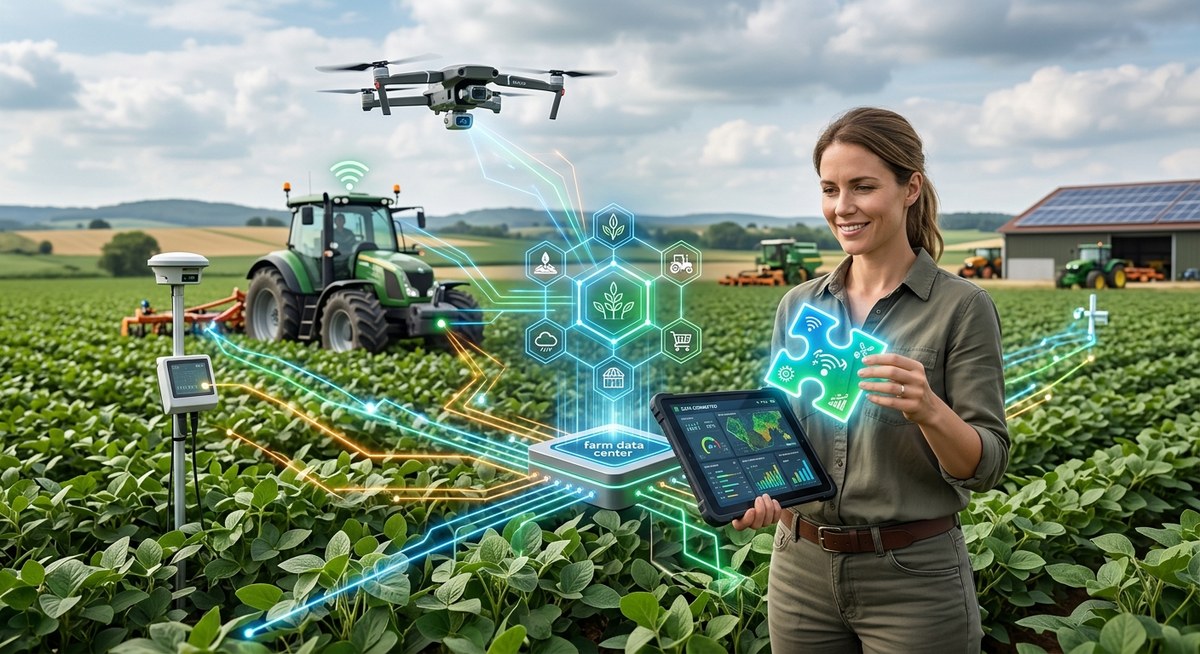
You have sensors in the field, a yield monitor on the combine, weather data from a subscription service, and soil maps from your agronomist. Each tool produces valuable numbers. But when you try to compare last year’s planting depth with this year’s moisture readings, you end up copying data from one software to another by hand. That friction is costing you time and insight. Farm data interoperability is the missing piece that lets those systems talk to each other automatically, turning a pile of spreadsheets into a single dashboard you can trust.
Farm data interoperability means your sensors, software, and machines share information without manual steps. When systems talk, you can spot patterns faster, apply inputs precisely, and save hours each week. Without it, you face data silos, errors, and missed yield opportunities. This guide explains how to connect your digital tools to make smarter decisions in 2026.
Understanding farm data interoperability
Farm data interoperability is the ability of different digital tools and machines to exchange information and use that information together. Think of it as a common language for your tractor’s GPS, your irrigation controller, your crop modeling app, and your accounting software. When they speak the same language, data flows from one system to the next without you having to reformat files or retype numbers.
For example, a soil sensor reading from your field can automatically update the variable rate prescription in your planter, and that same reading can appear in your nutrient management report. That is interoperability. Without it, the sensor data sits in one app and the planter file sits in another, and you spend Sunday evening matching rows.
In 2026, the push for interoperability is stronger than ever. More farms are using tools like connected sprayers, drone imagery, and real-time weather stations. But buying new gadgets without planning how they will share data often leads to more confusion, not more clarity.
Why interoperability matters for your farm’s bottom line
Let’s look at a real-world scenario. A corn grower in Iowa uses a soil moisture network, a variable rate fertilizer system, and a cloud based record keeping tool. Without interoperability, the moisture data stays in the sensor provider’s app. The grower manually downloads it, prints a PDF, then reenters the numbers into the fertilizer planner. That process takes about two hours per field per week. Over a season, that is over 40 hours of data entry. And mistakes happen.
With interoperability, the sensor data feeds directly into the planner. The system adjusts nitrogen rates on the fly based on real moisture levels. The grower saves 40 hours and likely gains yield by applying fertilizer only where it is needed. That is a direct return on investment.
Farm data interoperability also supports compliance and sustainability reporting. Buyers and auditors often ask for detailed field records. If your data is scattered across five platforms, pulling together a report becomes a headache. Interoperability lets you generate a single, accurate report in minutes.
The real cost of disconnected data
Data silos are expensive. Some costs are easy to see: extra labor, late decisions, duplicate data. Others are hidden: missed opportunities because you did not see a pattern soon enough.
Here are common symptoms of low interoperability:
- You manually export CSV files and import them into another program.
- Your yield monitor data does not match your soil sample grid.
- You cannot overlay drone imagery with historical weather data without editing file names.
- Your agronomist uses a different platform than your sprayer software.
Each of those gaps erodes trust in your data. If you spend time cleaning data instead of analyzing it, you are losing the advantage digital tools promised.
How to build a connected data ecosystem
Achieving farm data interoperability does not require replacing all your equipment. It starts with planning and choosing the right standards. Follow these steps:
-
Audit your current tools. List every piece of software, sensor, machine, and data source on your farm. Note which ones can export data in a standard format like ISO 11783 or JSON. Check for API access or cloud sync options.
-
Choose a central platform. Select a farm management information system (FMIS) that supports open data standards. Many platforms now connect to the leading hardware brands. Test if your main tools already have prebuilt integrations.
-
Standardize your field identifiers. Use the same field names and boundaries across all systems. If your planter calls a field “North 40” but your scouting app calls it “Field 12A”, they cannot match records. Use a consistent boundary shapefile or GeoJSON for every field.
-
Set up automated data flows. Configure your tools to push data to the central platform automatically. For example, connect your weather station to upload hourly readings. Connect your yield monitor to upload after harvest. Automation removes the manual step.
-
Test and validate. Run a small pilot on one field. Verify that data from the planter matches data from the soil app. Check that the yield map colors match your as applied maps. Fix any mismatches before scaling.
-
Train your team. Make sure everyone who uses the tools understands the new data flow. Show them where to find alerts and how to troubleshoot a broken connection.
Common interoperability pitfalls to avoid
Even with a plan, farms hit roadblocks. The table below shows typical mistakes and how to avoid them.
| Mistake | Why it hurts | How to fix it |
|---|---|---|
| Using a data format that only one app reads | You cannot move data to other platforms easily | Choose equipment that supports open formats like ISO 11783 or AgGateway standards. |
| Skipping field boundary calibration | Data layers do not align spatially | Use RTK GPS to create precise field boundaries once, then share the files across all tools. |
| Relying on manual file transfers for months | Errors and delays become routine | Automate every transfer you can. If a tool lacks an API, consider replacing it. |
| Ignoring firmware updates on sensors and machines | New interoperability features often come via updates | Set a quarterly schedule to update all device firmware and software. |
| Not testing a new integration before a key season | You discover broken links at planting time | Test new connections at least a month before you need them. |
Expert take
“The farms that get ahead in 2026 are not the ones with the most data. They are the ones whose data works together. Interoperability turns information into action. Start by connecting one tool to another this year, not all at once. A single connection that works well is better than ten that fall apart.”
— Doug Miller, digital agriculture consultant
Tools and technologies enabling farm data interoperability
Several technologies are making interoperability easier for farmers today.
IoT devices are the eyes and ears of the modern farm. They collect soil moisture, temperature, and crop health data. When these devices use standard protocols like MQTT or OPC UA, they can push data directly into your FMIS. For more on how to set this up, read our guide on
Data analytics platforms can process interoperability data to spot trends. For example, combining yield maps with soil type layers reveals which zones need different seeding rates. Learn more in
Digital soil sensors are a perfect candidate for interoperability. A single sensor can feed both your irrigation controller and your nutrient planner. See how to integrate them in
AI powered tools can analyze interoperable data across seasons. They learn from your field history to recommend planting dates or fungicide timing. For an introduction, visit
Drones capture high resolution imagery that becomes more valuable when aligned with other layers. To make those images work with your existing map platform, check out
Predictive analytics relies on clean historical data from multiple sources. Interoperability gives those models the complete picture they need. Read more in
Edge computing processes data close to the sensor, reducing the need for constant cloud uploads. It can still forward standardized data to your central system. Learn how in
Taking the first steps toward a unified farm data strategy
Farm data interoperability is not a technology problem. It is a planning problem. You already own capable tools. The missing piece is the decision to make them work together.
Begin with one connection. Maybe that is linking your weather station to your irrigation scheduling software. Or connecting your yield monitor to your field record app. Once you see the time you save and the patterns you notice, you will be motivated to add the next link.
In 2026, the farms that thrive will be those that treat data as a team member, not a collection of isolated reports. Start building your connected data ecosystem today. Your fields will thank you, and so will your bottom line.
