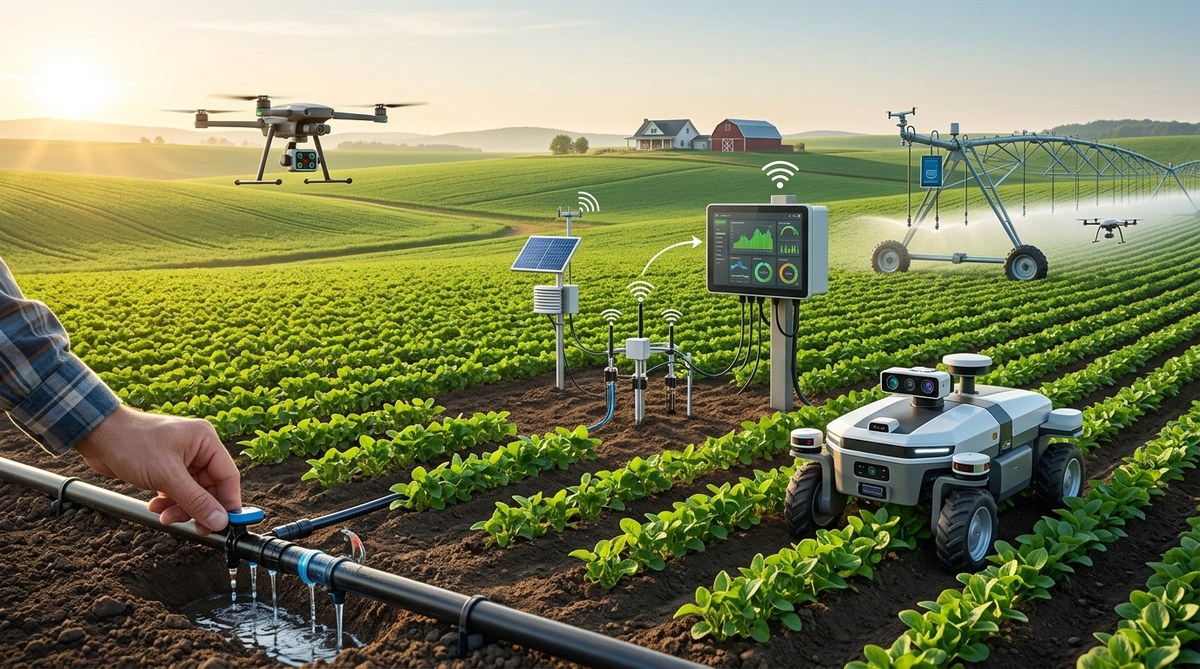
Water is the new gold in agriculture. With aquifers dropping and droughts becoming a regular part of the growing season, farmers across the Midwest and California are feeling the squeeze. The good news? A wave of smart farming innovations to reduce water usage in 2026 has hit the market, and they are not just for big operations with deep pockets. These tools are practical, field-tested, and capable of cutting your water bill by 30 percent or more. If you are tired of watching water run off your fields and straight into the drainage ditch, this article is for you.
Farmers adopting smart irrigation technologies in 2026 routinely see 30 percent less water use while maintaining or boosting yields. The five innovations that deliver the biggest returns are soil moisture sensor networks, AI-driven variable rate irrigation, drone-based thermal imaging, predictive weather analytics, and automated drip retrofits. Each tool pays for itself within one to two growing seasons.
Why Every Drop Matters More Than Ever
The USDA reported that irrigation accounts for roughly 80 percent of all freshwater consumed in the United States. That statistic hits hard when you are looking at a dry forecast and rising electricity costs to run those pivots. In 2026, the pressure is on from every angle. Consumers want sustainably grown food, regulators are tightening water permits, and your profit margin depends on keeping input costs low.
Cutting water usage is not just about conservation. It is about survival. When you use less water per acre, you free up capacity to farm more land, reduce energy bills, and protect your crops against stress during dry spells. The innovations below are ranked by how fast they can lower your water use without sacrificing bushels.
1. Soil Moisture Sensor Networks That Tell You Exactly When to Irrigate
Guessing when to turn on the pivot is the fastest way to waste water. You either run it too early, too late, or too long. Soil moisture sensors remove the guesswork entirely.
These small devices are buried at multiple depths in the root zone. They send real-time data to your phone or tablet. You can see exactly how much moisture is available at 6 inches, 12 inches, and 24 inches down. When the lower zone still has water, you delay irrigation. When the top layer dries out, you run a precise amount of water no more, no less.
How to set up a sensor network on your farm
- Map your field variability. Walk the field with a soil probe and note areas with sandy soil, clay pockets, and slopes. Each zone needs its own sensor.
- Install sensors at two to three depths. Place one at 6 inches, one at 12 inches, and one at 24 inches for each monitoring station.
- Connect to a central dashboard. Most modern sensors use LoRaWAN or cellular signals so you do not need Wi-Fi in the middle of a corn field.
- Set threshold alerts. Program the system to text you when moisture drops below 30 percent available water capacity in the top zone.
- Review weekly trends. Look at the drying curve to predict when the next irrigation event will be needed.
Farmers who installed sensors last year reported cutting irrigation events by 40 percent. That translates directly into lower pump costs and less runoff. If you want a deeper look at how these devices work, check out our guide on implementing digital soil sensors for better crop management outcomes.
2. AI-Driven Variable Rate Irrigation
Variable rate irrigation (VRI) is not new. But pairing it with artificial intelligence is the game changer for 2026. Older VRI systems relied on static maps that you updated once a season. Modern AI-driven systems adjust in real time based on soil moisture readings, plant stress data, and weather forecasts.
How AI changes the irrigation game
| Traditional VRI | AI-Powered VRI |
|---|---|
| Uses a single soil map updated yearly | Updates prescription zones every few hours |
| Requires manual input from the farmer | Learns from sensor data and adjusts automatically |
| Applies water based on fixed zones | Creates microzones as small as 10 feet |
| No integration with weather data | Pulls forecast data to skip irrigation before rain |
The result is a system that applies water only where and when it is needed. A grower in Nebraska using AI-driven VRI on 1,200 acres of corn cut water use by 32 percent in 2025 while seeing a 5 percent yield bump. The key is that the AI learns the unique behavior of each field as the season progresses.
If you are curious about whether this kind of technology fits your operation, read our breakdown on is precision agriculture worth the investment in 2026. The short answer is yes, especially when water costs keep climbing.
3. Drone-Based Thermal Imaging for Early Stress Detection
By the time you see leaves curling, your crop has already been stressed for days. Drone thermal imaging catches water stress before it is visible to the naked eye. A drone equipped with a thermal camera flies your field and maps surface temperature differences. Stressed plants transpire less and run warmer. The drone pinpoints those hot spots with GPS accuracy.
What a thermal drone survey reveals
- Hot zones where irrigation coverage is uneven
- Leaking valves or broken emitters in drip systems
- Areas with compaction that prevent water infiltration
- Early signs of disease that thrive on stressed plants
- Drainage patterns that cause water pooling
You can run a thermal survey every three to five days during peak growth. The cost per acre has dropped below 8 dollars in 2026, and many drone services now offer subscription plans. Combine thermal imaging with soil sensor data and you have a complete picture of your field’s water status.
For a full guide on getting started with aerial surveys, see our article on how to leverage drone technology for precision farming in 2026.
4. Predictive Weather Analytics That Stop You from Wasting a Rain Event
How many times have you irrigated a field only to get a soaking rain the next day? Every one of those events is wasted money and wasted water. Predictive weather analytics solve this problem by connecting your irrigation controller directly to hyperlocal forecast data.
These platforms do more than tell you if it might rain. They analyze atmospheric pressure, soil temperature trends, and storm probability models to give you a tailored irrigation recommendation. Some systems can even automatically delay your pivot start if there is an 80 percent chance of precipitation within 12 hours.
“We used to run the pivot on a schedule no matter what. After we connected our controller to a predictive weather service, we skipped seven full irrigation cycles in one season. That saved us roughly 50 dollars per acre in electricity and water costs.” * — Mark Thompson, corn and soybean grower in central Iowa*
The best part is that these platforms are getting cheaper. Several providers now offer subscriptions for under 500 dollars per year for a single farm. When you consider that each skipped irrigation cycle saves you money, the ROI is almost instant.
If you want to see how data analytics can transform your whole operation, take a look at our resource on top strategies for using data analytics to maximize crop yields.
5. Automated Drip Retrofit Kits for High-Value Crops
Drip irrigation has always been the gold standard for water efficiency. The problem has been cost and labor. Traditional drip systems require manual valve adjustments and frequent checks for clogs. In 2026, automated drip retrofit kits have changed the equation.
These kits fit onto existing drip lines and add solenoid valves, pressure regulators, and a small controller at each zone. You can manage everything from your phone. The system flushes lines automatically to prevent clogs and applies water in precise pulses that reduce deep percolation.
Fields where automated drip makes sense
- Vegetable operations with high water costs
- Orchards and vineyards where every gallon matters
- Specialty crop growers who need consistent soil moisture
- Greenhouses and high tunnels with limited water access
A tomato grower in Florida retrofitted 50 acres of drip irrigation in early 2025. By the end of the season, water use dropped 35 percent and yield increased 12 percent because the plants received consistent moisture during fruit set. The kit paid for itself in 14 months.
If you are thinking about integrating multiple smart systems on your farm, read our step-by-step guide on 7 steps to building a fully integrated smart farm system. It walks you through connecting sensors, irrigation controllers, and data dashboards into one seamless platform.
Common Mistakes Farmers Make When Adopting Water-Saving Tech
Adopting new technology is exciting, but there are a few traps that can kill your ROI. Here is a list of the most common mistakes to avoid.
- Installing sensors in only one spot and assuming the whole field is the same
- Ignoring the calibration process for moisture sensors
- Buying a drone without a clear plan for analyzing the data
- Setting weather alerts too conservatively and missing rain events
- Overcomplicating the dashboard and then giving up on using it
- Skipping training for the crew that operates the equipment
The best approach is to start small. Pick one field, install a sensor network, and learn how to read the data before scaling up. Partner with a local agronomist or extension agent who has hands-on experience with these tools.
For a complete roadmap on putting all these pieces together, check out our comprehensive post on top digital technologies revolutionizing sustainable farming practices.
Your First Step Toward Smarter Water Use in 2026
You do not need to buy every tool on this list tomorrow. Pick the one that solves your biggest pain point first. If you never know when to start the pivot, start with soil moisture sensors. If you are tired of irrigating before a storm, sign up for a predictive weather service. If your drip system is older than your tractor, look at an automated retrofit kit.
The farmers who are cutting water use by 30 percent in 2026 are not doing anything magical. They are using tools that are available right now, installing them correctly, and trusting the data. You can do the same. Start with one field, one sensor, and one season. The water you save will pay dividends for years to come.
