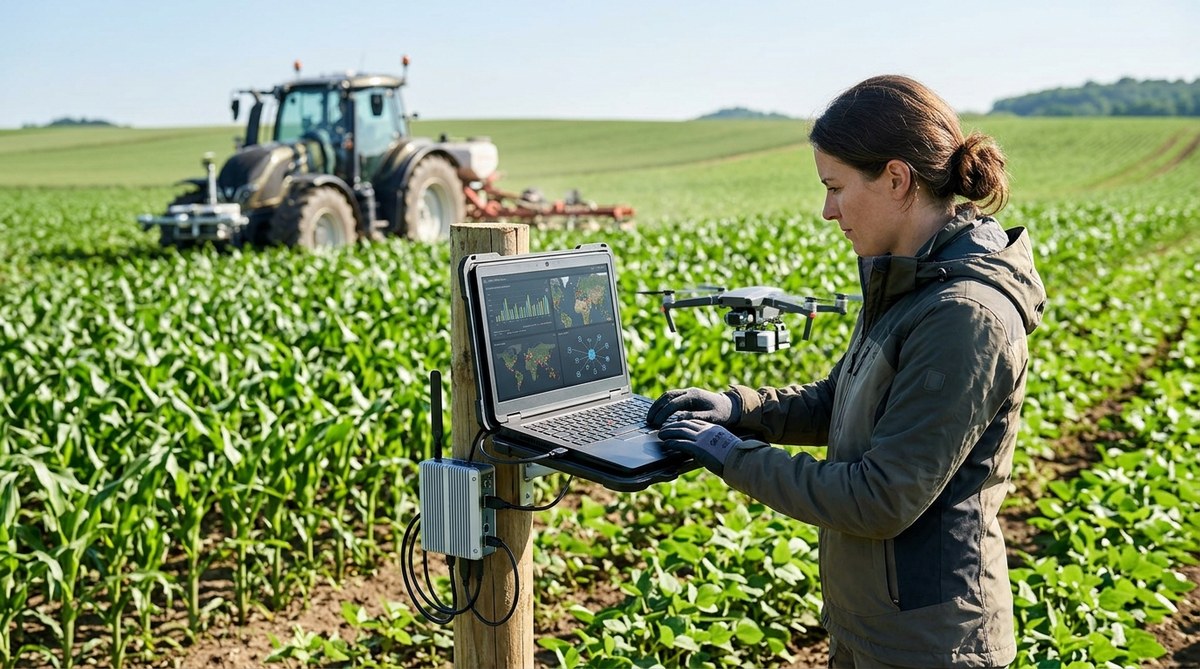
Picture a cornfield stretching to the horizon. Hundreds of sensors track moisture, nitrogen, and pest pressure. Every second, data streams in. If that data travels all the way to a distant cloud server for processing, you wait. And while you wait, a disease could spread or an irrigation window could close. That is the problem edge computing solves.
Edge computing brings the processing power right to the field. Instead of sending raw data to the cloud and back, a local device analyzes it on the spot. Decisions happen in milliseconds. For a farmer in the Midwest facing a sudden hail threat or a sudden spike in soil salinity, that speed changes everything.
Edge computing smart farming lets you process data at the source, slashing latency from minutes to milliseconds. By analyzing sensor readings and drone imagery right in the field, you catch problems before they escalate. This guide shows you the exact steps to set up an edge system, common mistakes to avoid, and how real farms are already reaping the rewards.
Why Speed Matters More Than Ever in Modern Farming
Farming has always been a race against time. But the stakes are higher now. Weather patterns shift unpredictably. Input costs climb. A delayed decision on irrigation or pesticide application can cost you a full percentage point of yield. Traditional cloud based IoT systems are good for historical analysis, but they choke on real time demands.
An edge device installed on a pivot irrigator, inside a greenhouse, or attached to a drone processes data locally. It sends only the meaningful results to the cloud for storage and trend analysis. This hybrid approach gives you the best of both worlds: instant action at the edge plus long term insights from the cloud.
Consider a scenario where a soil sensor detects a sudden drop in moisture during a critical growth stage. With edge computing, the controller adjusts the drip tape within a second. Without edge, the data travels to a server hundreds of miles away, waits in a queue, and a response travels back. By then, the crop has already endured stress.
How Edge Computing Smart Farming Works in Practice
An edge system for agriculture typically includes three layers:
- Sensors and devices that measure soil, weather, crop health, and equipment status.
- Edge gateways or processors that run lightweight AI models and rule engines right there in the field.
- Cloud platform that aggregates processed data for broader analytics, reporting, and machine learning training.
The magic happens in step two. A small computer resembling a rugged Raspberry Pi or a dedicated industrial gateway receives continuous data. It runs algorithms trained to spot anomalies. When it sees something off, it triggers an action immediately: turn on a fan, close a valve, send an alert to your phone.
A Closer Look at the Data Flow
Let us break down the processing pipeline step by step. This is how a typical edge computing smart farming system handles a real time reading.
- Data capture – A digital soil sensor reports volumetric water content at 10 second intervals.
- Local filtering – The edge gateway checks if the value falls outside a preset threshold (e.g., below 25% or above 60%).
- Local analysis – If outside threshold, the edge device runs a short predictive model to estimate how long until wilting point.
- Action – The edge controller signals the irrigation valve to open for 5 minutes, then reseals.
- Notification – The edge sends a compact summary to the cloud: “Zone 4 irrigated for 5 min at 14:32 due to moisture drop.”
That sequence takes under a second. Compare that to the cloud only route where the sensor data uploads, is queued, processed, returned, and then acted upon. The cloud route may take 10 seconds to 2 minutes depending on connectivity.
Common Techniques and Mistakes in Edge Deployments
Not every edge setup is equal. The table below compares effective approaches with the pitfalls that many early adopters face.
| Technique | What to Do | What to Avoid |
|---|---|---|
| Model placement | Run lightweight inference models directly on the edge device. | Overloading the edge with a heavy deep learning model that slows response. |
| Data retention | Keep only trend summaries and anomalies on the edge, send raw logs to cloud weekly. | Storing every raw data point locally, filling memory and causing failures. |
| Connectivity handling | Design for intermittent or poor internet. | Relying on constant high speed connection; edge systems must work offline. |
| Device selection | Choose rugged, temperature tolerant hardware with power efficiency. | Using consumer grade routers or desktop computers in dusty, humid environments. |
| Security | Encrypt data in transit and at rest; update firmware regularly. | Leaving default passwords or skipping updates, making the system vulnerable. |
Expert advice from an agri tech engineer: “The biggest mistake I see is treating edge devices like mini cloud servers. They are not. You need to prune your models to run efficiently on limited hardware. A good rule is: if the inference takes longer than 100 milliseconds, your model is too heavy for field deployment. Optimize it or split the workload between edge and gateway.”
Practical Benefits You Can Measure
The proof is in the numbers. Farms using edge computing smart farming often see:
- Reduced response time to critical events from minutes to milliseconds.
- Lower cloud data costs because only essential data is transmitted.
- Better reliability because the system functions even when internet is down.
- Higher irrigation efficiency by stopping overwatering and underwatering immediately.
- Improved pest control as trap cameras can identify insects locally and trigger sprayers without waiting for human review.
Edge also helps with predictive maintenance. A vibration sensor on a tractor sprocket can detect a slight wobble, alert the operator, and prevent a breakdown during harvest. All without sending data off the farm.
To get started, you should first identify your biggest pain point. Is it irrigation timing? Disease detection? Equipment downtime? Start with one use case, deploy a small edge network, and scale from there.
For a deeper look at how IoT devices lay the foundation, check out our guide on harnessing IoT devices to transform modern farming practices. And if you want to understand how soil sensors feed into edge computing, read about implementing digital soil sensors to boost crop health and productivity.
Where Edge Computing Is Heading in Agriculture
By 2026, edge computing smart farming is no longer a niche experiment. It is becoming standard on progressive operations. We are already seeing integrated systems where edge devices communicate with each other, forming a local mesh network that shares insights across a whole farm without any cloud involvement.
Drones equipped with onboard edge processors can now scan fields, identify weeds, and send micro spray commands to a separate UAV in under two seconds. This kind of coordinated action was impossible just a few years ago.
The next wave will combine edge computing with AI powered computer vision. A camera mounted on a harvester can spot underripe fruits and adjust the picking arm in real time. This reduces waste and improves pack out quality.
If you are considering adding edge computing to your farm, start small but start now. Pick one field, one sensor type, and one rule. Run it for a season. Measure the difference in response speed and input savings. Then expand.
For a broader perspective on the tech stack, read about integrating AI powered tools for smarter crop management and top digital technologies revolutionizing sustainable farming practices.
Your Next Step Toward Faster Decisions
Edge computing smart farming puts control back in your hands. Instead of waiting for a cloud server miles away, your field equipment can react instantly to what it senses. That means less waste, lower risk, and more time to focus on the big picture.
Set a goal for this season. Choose one action that takes too long today. Does your irrigation system wait for a manual check? Do your pest traps alert you only after you check email? Pick that pain point and test an edge solution. The technology is affordable and the payoff is immediate.
Remember, you do not need to overhaul everything overnight. A single edge gateway connected to a few sensors can save you hours of back and forth. Once you see the speed difference, you will wonder how you farmed any other way.
For a step by step approach to building a complete system, see our guide on 7 steps to building a fully integrated smart farm system. And if you are still on the fence about whether precision ag is worth the investment, the article is precision agriculture worth the investment in 2026 will help you run the numbers.
Edge computing is not just a buzzword. It is the tool that makes smart farming actually smart. Deploy it, test it, and let the data prove it.
