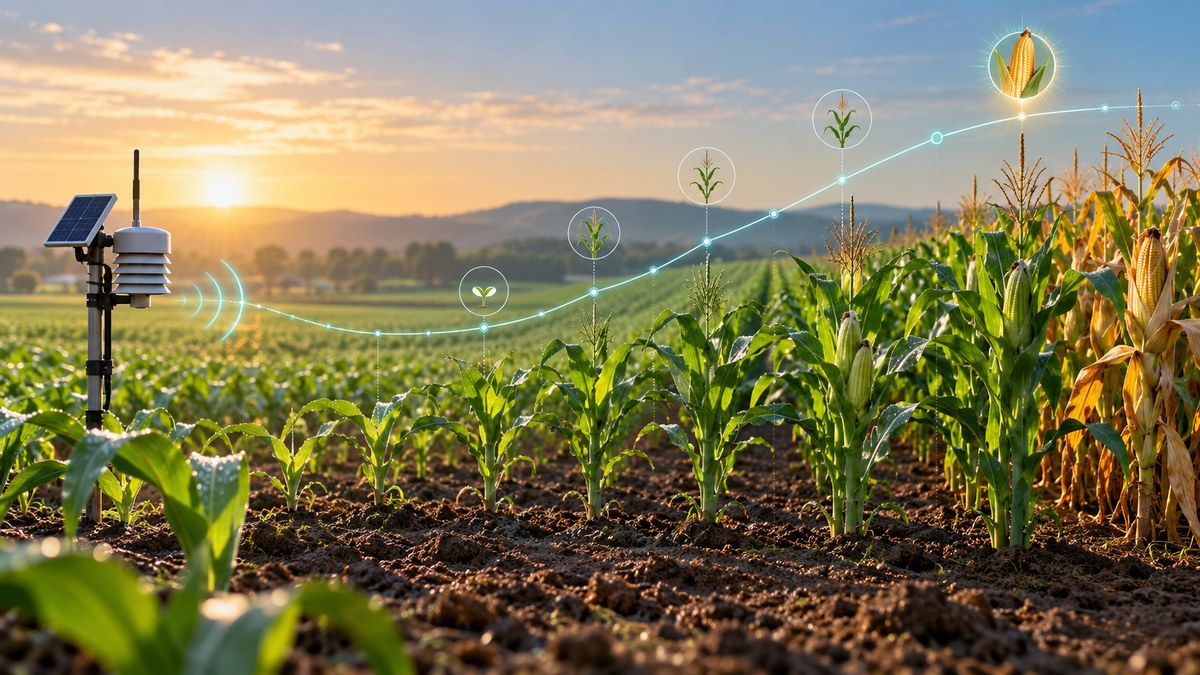
You have spent weeks monitoring soil moisture, tracking pest pressure, and dialing in your irrigation schedule. But when the combine finally rolls into the field, the crop is either too wet or overripe. A few days off can cost you thousands of dollars in quality discounts, missed market premiums, or extra drying fees. That gap between what you planned and what actually happens is exactly what a real time crop growth model is built to close.
A real time crop growth model uses live sensor data, weather forecasts, and plant physiology to predict harvest dates within days. Instead of guessing based on calendar averages, you get a dynamic, field-specific window that adjusts as conditions change. This cuts waste, improves grain quality, and lets you schedule labor and logistics with confidence.
Why guessing the harvest date costs more than you think
Most farm managers still rely on growing degree days (GDD) or simple calendar benchmarks to estimate maturity. Those methods work fine in an average season. But 2026 has already thrown us a wet spring in the Corn Belt and a dry July across parts of the Northern Plains. Static models cannot keep up.
When you guess wrong, the consequences pile up:
- Grain quality drops. Harvesting too early means high moisture and test weight penalties. Harvesting too late means shattering, lodging, or sprout damage.
- Logistics get messy. You book trucks, drying capacity, and seasonal labor weeks in advance. A missed window leaves you scrambling or paying overtime.
- Field operations overlap. If your corn harvest runs late, it pushes back soybean harvest, which delays fall tillage, which pushes into winter.
- Storage and drying costs spike. Wet grain pulled early burns through propane and shrinks your bottom line.
A real time crop growth model solves all of these by giving you a living, breathing forecast that updates with every weather event.
What a real time crop growth model actually does
Think of it as a digital twin of your field that ages the crop day by day. It pulls in data from multiple sources and runs a simulation of plant development in hourly steps.
The core inputs
| Input source | What it measures | Why it matters |
|---|---|---|
| On-farm weather stations | Temperature, humidity, solar radiation, wind speed | Drives evapotranspiration and heat unit accumulation |
| Soil moisture sensors | Volumetric water content at multiple depths | Water stress directly speeds up or slows down grain fill |
| Satellite or drone imagery | NDVI, canopy temperature, leaf area index | Confirms the model matches what you see in the field |
| Local forecast APIs | 7 to 14 day temperature and precipitation outlook | Extends the prediction window beyond current conditions |
| Hybrid maturity data | Relative maturity (RM) rating for your specific seed | Sets the genetic baseline for the growth curve |
The model does not just add up heat units. It accounts for stress factors. A corn plant that runs out of water during grain fill will reach black layer earlier than a well-watered plant. A soybean crop that experiences a cool, cloudy stretch will delay pod fill. The model adjusts the predicted harvest date in real time.
How to set up a real time crop growth model on your farm
You do not need a PhD in agronomy or a six-figure software license. Here is a practical five-step process to get started this season.
-
Choose your model platform. Several ag tech companies now offer subscription-based crop growth models that plug into your existing data. Look for one that accepts live sensor feeds and weather APIs. Avoid platforms that require manual data entry. Automation is the whole point.
-
Connect your field sensors. At minimum, you need a local weather station and soil moisture sensors in each management zone. If you already have IoT devices in the field, check whether the model platform supports their data format. Many platforms harness IoT devices to transform modern farming practices and accept common protocols like MQTT or LoRaWAN.
-
Calibrate with hybrid and planting date. Enter the relative maturity rating and the actual planting date for each field. The model uses this as the starting point. If you planted the same hybrid across multiple dates, treat each planting pass as a separate simulation.
-
Set your target harvest moisture. The model will predict when the crop reaches your preferred moisture level, whether that is 15% for corn or 13% for soybeans. This is the trigger for your harvest window.
-
Review and trust the alerts. The model will send you a push notification or dashboard update when the predicted harvest date shifts by more than a day or two. Use that information to adjust your logistics plan.
“The first year we used a real time crop growth model, we thought the prediction was too early. We waited three extra days and paid for it with a moisture discount. Now we follow the model and our grain quality has never been better.” — Mark T., precision ag specialist, central Illinois
Common mistakes when using crop growth models
Even the best tool fails if you feed it bad data or ignore its signals. Here are the most frequent errors farm managers make.
| Mistake | Why it happens | How to fix it |
|---|---|---|
| Using one sensor per 160 acres | Soil moisture varies widely across fields | Install at least one sensor per management zone |
| Ignoring the forecast extension | You only look at the current day | Set the model to pull a 14 day forecast automatically |
| Not updating hybrid RM data | You planted a new variety but kept old settings | Verify RM rating with your seed dealer each spring |
| Overriding the model with gut feel | You think the crop looks ahead or behind schedule | Run a side-by-side comparison for one season to build trust |
| Forgetting to recalibrate mid-season | The model drifts if not checked against reality | Walk fields and compare growth stage to the model weekly |
Using a real time crop growth model is not a set-it-and-forget-it tool. It works best when you treat it like a partner. Check the dashboard, compare it to field observations, and let it inform your decisions rather than replace your judgment.
How a crop growth model changes your harvest planning
Once the model is running, your entire operation shifts from reactive to proactive. Here is what that looks like in practice.
Labor scheduling. Instead of calling your custom harvest crew with a vague “maybe next week,” you give them a five day window that tightens as the crop matures. They can plan their own schedules, and you avoid paying standby fees.
Drying and storage. You know days in advance whether you will need extra propane or whether the crop will field dry naturally. That lets you lock in fuel prices before a cold snap spikes demand.
Logistics coordination. If you work with a grain elevator, you can book delivery slots that match the predicted harvest flow. No more sitting in a line or paying demurrage.
Field sequencing. The model tells you which fields will be ready first. You can route the combine to the highest priority acres and avoid the chaos of running the entire farm at once.
For a deeper look at how data transforms the entire operation, check out top strategies for using data analytics to maximize crop yields. The same data streams that feed your growth model can also inform fertility, pest management, and irrigation decisions.
Real time crop growth model vs. traditional GDD
Growing degree days have been the standard for decades. They work because temperature is the main driver of crop development. But they have blind spots.
A real time crop growth model improves on GDD in four key ways:
- It accounts for water stress. A plant under drought stress will accelerate maturity to reproduce before it dies. GDD models miss this entirely.
- It uses solar radiation. Cloudy days slow photosynthesis and delay grain fill. The model sees this; a GDD calculator does not.
- It adjusts for nighttime temperatures. Warm nights increase respiration and can shorten the grain fill period. The model tracks this daily.
- It simulates the whole plant, not just heat. The model considers root depth, canopy cover, and nutrient status if you feed it those data streams.
If you are still using a GDD spreadsheet, you are leaving money on the table. The upgrade to a real time crop growth model is like switching from a paper map to GPS navigation. Both get you there, but one adapts to traffic, road closures, and weather in real time.
Integrating the model with your broader precision ag system
A crop growth model does not live in a silo. It works best when it pulls data from and feeds data into your other precision ag tools.
For example, if your smart sensors are revolutionizing irrigation efficiency in 2026, the soil moisture data they collect becomes a direct input to the growth model. When the model detects that a field is approaching water stress, it can trigger an alert to your irrigation controller to adjust the schedule.
Similarly, if you use computer vision for real time crop monitoring in 2026, the canopy coverage data from those cameras can validate what the model is predicting. If the model says the crop is at R5 (dent) but the camera shows mostly green husks, you know something is off and can investigate.
The more data you integrate, the more accurate the model becomes. That is the beauty of a system that learns and adjusts.
What to look for in a crop growth model platform
Not all models are created equal. When you evaluate platforms for your farm, ask these questions:
- Does it accept live data feeds? Manual data entry defeats the purpose of real time.
- Can it handle multiple fields and hybrids? You need one dashboard for the whole farm, not separate logins.
- Does it include a forecast extension? A model that only looks at past weather cannot predict future harvest windows.
- Is the user interface simple? You should be able to see your top three fields and their predicted harvest dates in under 10 seconds.
- Does it integrate with your existing tools? Check for APIs or partnerships with your sensor brand, weather service, and farm management software.
Many of the top digital tools transforming modern farming practices now include built-in crop growth models. If you already use a farm management platform, check whether they offer this feature as an add-on before buying a standalone product.
The financial case for a real time crop growth model
Let us run a quick example. A 1,000 acre corn farm with an average yield of 200 bushels per acre and a market price of $5.00 per bushel grosses $1,000,000. A two day delay in harvest that causes a 2 point moisture penalty (from 15% to 17%) costs roughly $0.04 per bushel in drying and shrinkage. That is $8,000 lost.
Add in the risk of lodging from a wind event during that two day delay, and the cost can jump to $20,000 or more in a bad year.
A real time crop growth model subscription costs between $500 and $2,000 per year for a farm this size. The return on investment is immediate. One avoided penalty pays for the tool for several years.
Beyond the direct savings, there is the peace of mind. Knowing exactly when each field will be ready lets you sleep better during the final weeks of the season. You stop checking the forecast every hour and start trusting the system.
Making the switch this season
You do not need to wait for next year. Most platforms can be set up in a few days, especially if you already have field sensors in place. Start with one or two fields that have the most variable history. Run the model alongside your usual GDD method for the first season. By harvest, you will see the difference.
If you are new to precision ag and want a broader overview first, read about boost your crop yields with innovative precision farming techniques. That guide will help you build the foundation that makes a crop growth model even more powerful.
Your next step toward smarter harvest planning
A real time crop growth model is not a futuristic concept. It is a practical, accessible tool that works with the data you already collect. It takes the guesswork out of harvest timing and puts you back in control of your schedule, your grain quality, and your bottom line.
Start small. Pick one field. Connect your sensors. Watch the model learn and adjust. By the time that field is ready to harvest, you will wonder how you ever managed without it. And next season, you will roll it out across the entire farm.
The combine will still roll. The grain will still flow. But you will know exactly when to start the engine and when to call the crew. That is the difference between farming by the calendar and farming with confidence.
