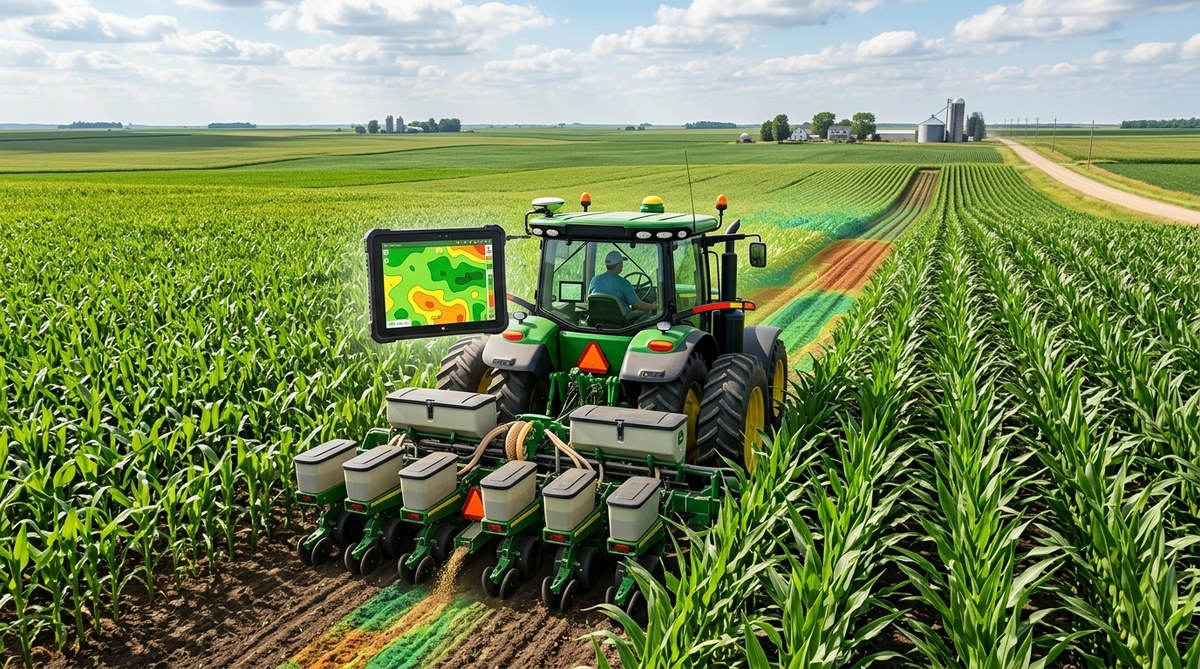
Corn fields are rarely uniform. Some areas produce 250 bushels per acre while others struggle to hit 150. You know this already. What you may not know is how much money you’re leaving on the table by treating every acre the same. Variable rate technology (VRT) changes that. It lets you match seed, fertilizer, and chemicals to the specific potential of each zone in your field. The question is: can it really push your corn yields higher? The short answer is yes. But the real story is in the details.
Variable rate technology for corn yields isn’t a gimmick. When applied correctly, VRT can increase productivity by 5 to 15 percent while reducing wasted inputs. The key is combining high-quality soil maps, prescription software, and calibrated equipment. This guide covers the process, common pitfalls, and real-world results. You’ll learn how to implement VRT on your farm and what return to expect.
How VRT Actually Boosts Corn Yields
Variable rate application works by changing the rate of an input across a field based on predefined zones. Instead of spreading a flat 200 pounds of nitrogen per acre, you might apply 180 in low potential areas and 220 in high potential areas. The same logic applies to seeding rates, phosphorus, potassium, and even fungicides.
Why does this matter for corn? Corn is especially sensitive to both underfeeding and overfeeding in different parts of the same field. A sandy knoll loses nitrogen fast, so it needs a different strategy than a heavy clay bottom. When you get those rates right, yields climb and input costs drop.
The benefits include:
- Higher overall yield from the field because you push the best acres harder
- Lower input costs on low performing zones, where extra fertilizer was wasted
- Better nitrogen use efficiency, which reduces loss to the environment
- More consistent grain quality at harvest
- Clearer data for next season’s decisions
The VRT Playbook: A Step by Step Process
Implementing variable rate technology for corn yields isn’t something you do in a weekend. It takes planning. Here is a straightforward process used by successful farmers in 2026.
-
Collect high resolution soil samples. A one sample per 2.5 acre grid is the minimum. Go for 1 acre grids if your field has high variability. Send samples to a lab that provides recommendations for corn.
-
Build management zones from yield maps. Use at least three years of yield monitor data to identify stable high and low areas. Overlay that with soil type maps and elevation data from a field in the spring.
-
Create prescription maps with software. Most growers use a platform like Climate FieldView or AgLeader SMS. The software combines your zone map with the agronomic rules set by your agronomist.
-
Calibrate your equipment before you go to the field. This step is often skipped. Run a test to verify that the controller responds correctly when it moves from one zone to another. A delay of a few feet can waste your investment.
-
Apply the prescription and monitor in real time. Watch the as applied data on the cab display. If something looks off, stop and check the set up.
-
Analyze the results after harvest. Compare the VRT zones against a uniform rate checkstrip if possible. Use that data to refine next year’s prescription.
For deeper insights on how data analytics support this process, see our guide on top strategies for using data analytics to maximize crop yields.
Common Mistakes That Kill Your ROI
I have seen growers spend thousands on VRT software and still not see a yield lift. The problem is almost never the technology. It is how they apply it. Here are the most frequent errors and how to sidestep them.
| Mistake | Consequence | Fix |
|---|---|---|
| Using soil data that is more than four years old | Prescription is based on outdated fertility levels | Resample every three to four years at minimum |
| Ignoring yield history for zone creation | Zones don’t reflect actual crop response | Overlay at least three seasons of yield data |
| Calibrating only one product (e.g., nitrogen) but not the others | Inconsistent application across materials | Run a full calibration for every product on the planter or sprayer |
| Working with a single year of data | Prescription may miss weather driven variability | Build zones from multiple years whenever possible |
| Setting unrealistic rate swings (e.g., 100 vs 300 units N) | Risk of lodging in high zones and deficiency in low zones | Keep the range within agronomic limits for your hybrid |
Real Numbers from 2026 Trials
During the 2025 growing season, a group of 40 corn farmers in central Illinois tested variable rate nitrogen side by side with their standard flat rate. The average result: a 9 bushel per acre increase on the VRT fields, with nitrogen savings of 18 pounds per acre. That combination added roughly $35 per acre to the bottom line.
One of those farmers, Mark from McLean County, said:
“I was skeptical until I saw the as applied map. The high yield zones got more nitrogen when the corn needed it most. The low ground got pulled back. After three years of this, my field average has gone from 198 bushels to 215. That’s real money.”
These results depend on the quality of your soil sensing and zone delineation. If you are considering adding digital soil sensors to your farm, read our article on implementing digital soil sensors to boost crop health and productivity.
Integrating VRT with Other Precision Tools
Variable rate technology works best when it is part of a larger precision system. The zones you create for VRT can also be used for variable rate seeding, variable rate irrigation, and even variable rate pest control. When you combine VRT with integrating AI-powered tools for smarter crop management, the prescription becomes dynamic. AI can adjust rates in season based on weather and crop sensors.
Similarly, harnessing IoT devices to transform modern farming practices gives you real time feedback on soil moisture and nutrient levels. That data can feed back into your VRT prescription for next season.
Another key integration is with how to leverage drone technology for precision farming in 2026. Drones with multispectral cameras can identify stress areas mid season. You can then update your nitrogen prescription on the fly if your equipment supports variable rate.
Is VRT Right for Your Corn Acres?
Variable rate technology for corn yields is not a universal fit. If your fields are extremely flat and uniform, the gains may be small. But for most growers in the Midwest and across the corn belt, fields have enough variability to justify the investment. The break even point usually comes when you have at least 20 acres of corn per field with contrasting soil types.
Start small. Pick one field with obvious variability. Run the six step process this year. Compare your results against a uniform control strip. Then decide if you want to scale.
Every field has a story. Variable rate technology helps you listen to that story and respond with the right amount of seed and fertilizer. When you do, your corn yields will reflect the true potential of every acre.
For more ways to use precise tools on your farm, take a look at maximize crop yields with precision farming technologies. And if you have not yet started with soil sensors, our page on implementing digital soil sensors for better crop management outcomes can point you in the right direction.
The technology is proven. The process is clear. Now it is up to you to give it a try on your own ground.
