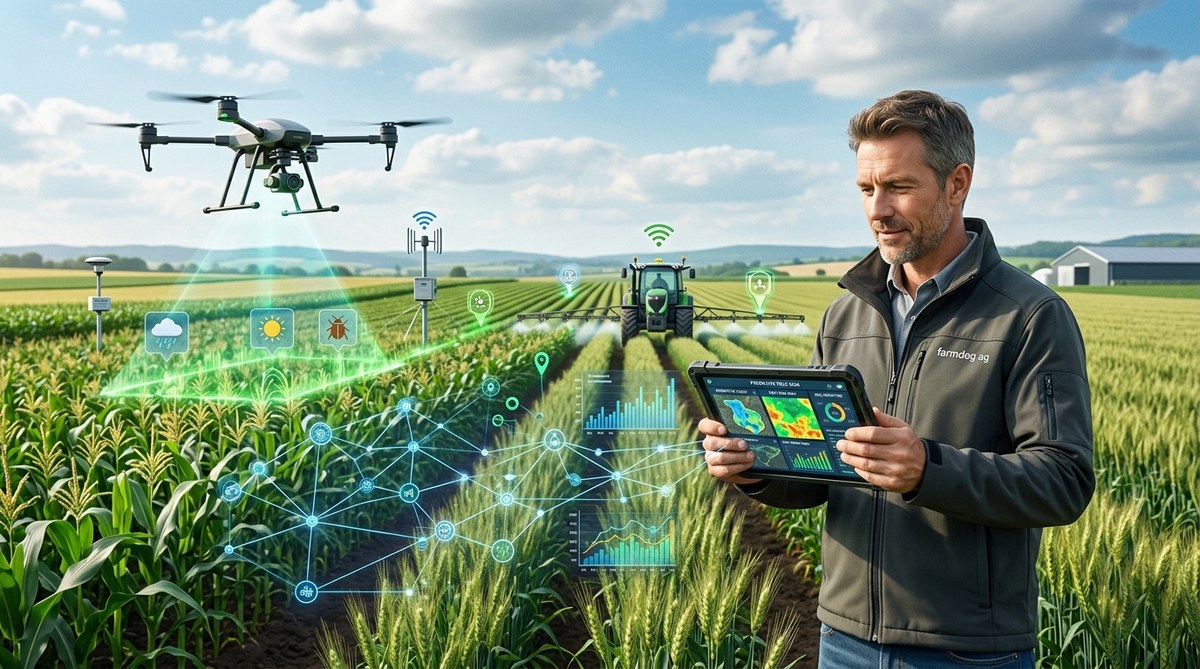
Every season brings a mix of hope and uncertainty. You plant seeds, watch weather patterns, and make your best guess about inputs. But what if you could know, with real confidence, exactly what your fields need before you make a move? That is the promise of predictive analytics in crop management.
Predictive analytics helps you turn historical field data, weather models, and satellite imagery into forward-looking decisions. In 2026, these tools are more accessible than ever. By adopting a few core practices like layering sensor data and using AI-driven models, you can reduce input waste, catch pest outbreaks early, and boost harvests. The result is a smarter, more profitable farm operation.
What Makes Predictive Analytics Different in 2026?
Farming has always been about reading signs. You look at soil texture, watch the sky, and recall what happened last season. Predictive analytics does the same thing, but with far more precision. It combines decades of local weather data, real-time soil sensor readings, and satellite images to create forecasts that update daily.
In previous years, running these models required a data science degree. That has changed. Platforms like FarmDog now package complex algorithms into dashboards that any farm manager can use. The 2026 versions integrate directly with your existing equipment and software. You get recommendations for planting dates, irrigation schedules, and even specific nitrogen rates for each zone.
The key shift is from reactive to proactive management. Instead of spraying for pests after you see damage, you receive alerts two weeks ahead. Instead of guessing fertilizer rates, you get a map that shows exactly where to apply more and where to cut back.
How to Start Using Predictive Analytics on Your Farm
Ready to put this into action? You do not need to overhaul everything at once. Follow these five practical steps to get started with predictive analytics in 2026.
-
Collect and organize your farm data. Start by pulling together at least three years of yield maps, soil test results, and planting records. The more history you feed the models, the better they will perform. If you are missing data, consider adding digital soil sensors this season to fill the gaps.
-
Connect your data sources to a prediction platform. Most modern ag tools allow you to upload CSV files or sync directly with your tractor’s telematics. Look for a platform that accepts weather forecast feeds and satellite imagery. This integration is where the magic happens, because the model compares past outcomes with current conditions.
-
Run a trial on a single field. Do not apply predictive recommendations across your whole farm until you test them. Pick one field with variable soil types. Use the model’s advice for that field while managing the rest with your usual methods. Compare the results at harvest.
-
Monitor and adjust weekly. Predictive models improve as they receive new data. Check the dashboard every week during the growing season. If the forecast changes, the platform will update its recommendations. You might shift a fungicide application by a day or two, or adjust irrigation based on an unexpected rain event.
-
Scale up and refine year over year. Once you see a positive return from the test field, expand to more acres. Each season adds more data, which makes the predictions stronger. Over time, you will learn which variables matter most for your specific location and crops.
The Major Benefits You Can Expect
Using predictive analytics is not just about higher yields. It touches every part of your operation. Here are the main advantages you can count on in 2026.
-
Lower input costs. You apply fertilizer and chemicals only where they are needed. One Wisconsin corn grower reduced nitrogen use by 18% after adopting zone-specific predictions from a data analytics platform.
-
Better pest and disease control. Models that track temperature and humidity can predict disease risk days before symptoms appear. This gives you time to apply targeted treatments instead of blanket sprays.
-
Reduced weather risk. Short-term weather models are now accurate enough to help you decide when to plant, when to irrigate, and when to harvest. You avoid costly mistakes like planting into a dry spell that turns into a drought.
-
Improved crop quality. Consistent soil moisture and nutrient levels lead to more uniform grain or fruit. Premium markets often pay more for quality, so your bottom line improves beyond just volume.
-
Time savings for you and your team. Instead of walking fields daily to scout, you check a map on your phone. The system highlights problem areas, so you can focus on the spots that need attention.
Common Pitfalls and How to Avoid Them
Even the best tool can lead to bad results if you use it wrong. The table below shows frequent mistakes that farm managers make with predictive analytics, along with strategies to sidestep them.
| Pitfall | How to Avoid It |
|---|---|
| Trusting a model blindly without ground truthing | Always validate predictions with in-field scouting or spot checks. Models are guides, not crystal balls. |
| Using only one data source (e.g., just weather) | Layer multiple inputs: soil moisture, NDVI, pest traps, and yield history. Each layer adds accuracy. |
| Skipping the calibration step | Run a pilot field for one season. Adjust the model’s sensitivity based on your actual results before going full scale. |
| Ignoring the human element | Train your agronomist or farm manager on how to interpret the dashboard. A tool is only as good as the person using it. |
| Expecting perfection in the first year | Predictive models improve with more data. Give it at least two seasons to show its full potential. |
Expert advice from a precision ag specialist: “Don’t fall into the trap of thinking more data is always better. Focus on the data that drives decisions. For example, knowing the soil organic matter map is more useful than a thousand random soil sample points. Quality beats quantity every time.” – Dr. Maria Kline, Agronomy Lead at Midwest Ag Data
A Practical Example: Pest Management with Predictions
Let us look at a real scenario from the 2026 season. A soybean farm in central Illinois had trouble with aphids. In previous years, the farm sprayed insecticides twice per season, but aphids still caused some yield loss. They started using a predictive analytics tool that combined trap counts, weather forecasts, and satellite-derived canopy cover.
The model flagged a high risk of aphid outbreak three weeks before the farmer saw any insects. It recommended a single, well-timed application of a selective insecticide. That one spray stopped the outbreak before it started. The farm saved the cost of a second spray and saw a 6% yield increase compared to the previous season. The same approach can be applied to managing pests in modern farming with data-driven timing.
The Role of IoT Devices and AI in 2026
Predictive analytics runs on data, and the best data comes from continuous monitoring. IoT devices like soil moisture probes, weather stations, and drone-mounted sensors feed live information into the models. In 2026, these devices are cheaper and more rugged than ever. They can operate for a full season on a single battery charge.
Artificial intelligence processes this data and spots patterns that humans would miss. For example, an AI model might recognize that a specific combination of soil temperature and wind speed leads to corn rootworm hatch. It will then recommend a cover crop or insecticide application at the exact right moment. This level of precision was impossible just a few years ago.
Addressing Common Concerns
Some farm managers worry that predictive analytics is too expensive or too complicated for their operation. In 2026, the cost has dropped significantly. Many platforms offer subscription pricing based on acres, so you pay only for what you use. Integration with common farm management software means you do not need to learn a completely new system.
Another concern is data privacy. Reputable providers let you control who sees your information. Look for platforms that offer data sovereignty agreements and never sell your field data to third parties. Always read the fine print before signing up.
Looking Ahead: Smarter Fields Start with Better Data
The future of crop management is already here. In 2026, predictive analytics is not a luxury for a few top producers; it is becoming a standard tool for anyone who wants to stay competitive. The farms that adopt it now will build a data advantage that compounds every year. Each season adds more information to the model, making next year’s predictions even sharper.
Start small. Pick one field, one crop, and one decision. Maybe it is nitrogen timing or irrigation scheduling. Run the numbers. Compare the outcome to your usual method. Once you see the difference, you will never want to farm without a forecast again.
The soil you manage today holds the key to tomorrow’s harvest. With predictive analytics, you can unlock that potential with less guesswork and more confidence. That is a game changer worth embracing.
