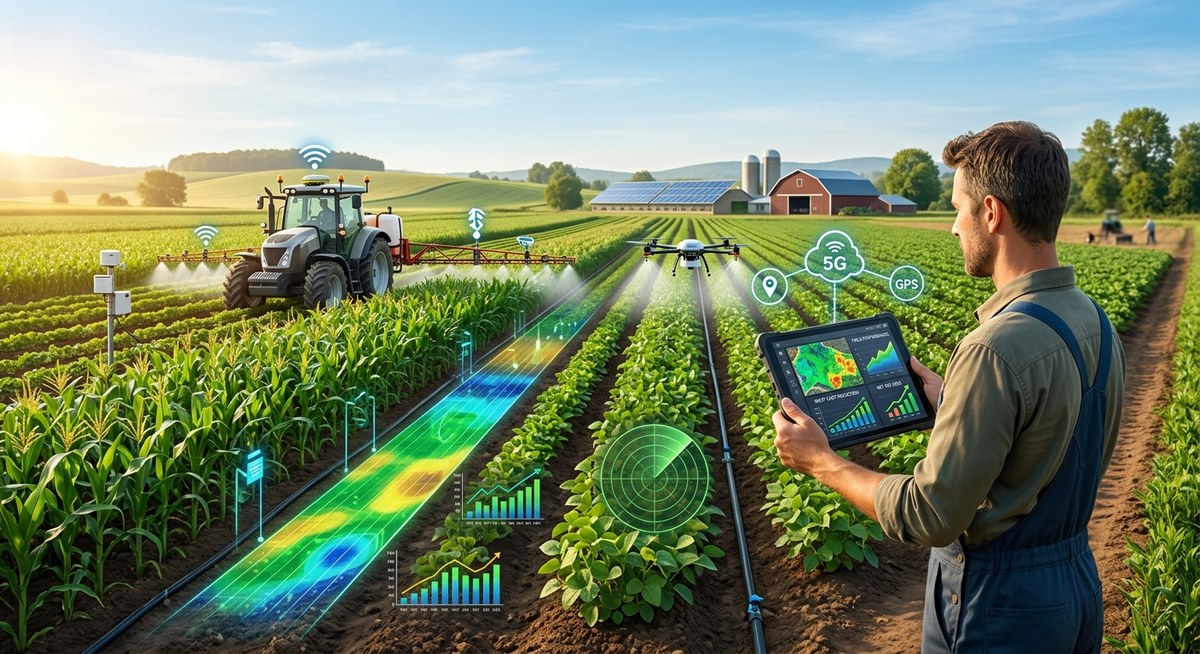
You are standing in your field, looking at your yield monitor from last season. You saw some great numbers in some zones, but others barely broke even. You keep hearing about precision agriculture investment 2026 and how it is supposed to save money and boost output. But you have also heard the horror stories: expensive equipment that never paid for itself, software that took months to learn, and data you never actually used. So, is it worth the money? The short answer is yes, but only if you go in with a clear plan. In this guide, we will walk through the real costs, the actual returns, and the pitfalls to avoid so you can decide if precision ag fits your operation this year.
Precision agriculture investment in 2026 can deliver strong returns, but only when matched to your farm’s size, crop mix, and existing challenges. The average ROI ranges from 10% to 30% over three years, with the highest gains coming from variable rate fertilization, real time soil sensors, and automated guidance. Start with a single proven technology rather than a whole suite, and track your numbers before and after. That approach turns guesswork into a profitable decision.
Understanding the Real Cost of Precision Ag in 2026
Let us talk dollars and cents first. A full precision setup including GPS guidance, variable rate technology, yield monitoring, and field mapping can run anywhere from $15,000 to $50,000 for the hardware and software in 2026. Add drones, soil sensors, and subscription analytics, and the number climbs higher. But here is the thing: you do not need to buy everything at once.
Many farmers start with a base GPS guidance system for around $2,000 to $5,000. That alone can reduce overlap during planting and spraying, saving 5% to 10% on seed, fertilizer, and fuel. On a 1,000 acre corn operation, that translates to $8,000 to $15,000 in annual savings. The payback period for guidance is often less than one season.
Then there is the subscription world. Data platforms like Climate FieldView or John Deere Operations Center cost $1,000 to $3,000 per year. That sounds like a lot until you use the data to identify low yielding zones and adjust inputs. One Nebraska corn grower I spoke with cut his nitrogen bill by 18% after one year of using variable rate application maps. His ROI was over 40% on that single change.
Benefits That Show Up on Your Bottom Line
Precision agriculture investment 2026 is not just about reducing input costs. It also protects your yield potential. Here are the main ways it pays off:
- Lower input waste – Variable rate seeding and fertilizing put the right amount where it belongs, not everywhere.
- Higher average yields – By correcting soil variability, you lift the low spots without overspending on the good ground.
- Better labor efficiency – Auto steer and section control let one operator cover more acres per hour.
- Improved record keeping – Digital records make it easier to prove sustainability practices for carbon credits or government programs.
- Reduced risk – Real time weather and soil moisture data help you make smarter irrigation and spraying decisions.
A recent study from Purdue University found that farmers using at least three precision technologies saw net returns $30 to $80 per acre higher than those using none. Over 500 acres, that is an extra $15,000 to $40,000 each year.
A Decision Framework: How to Evaluate Precision Ag for Your Farm
Follow these five steps to decide if a particular technology makes sense for you. We will use variable rate fertilization as an example.
- Identify your biggest inefficiency. Look at your last three years of yield maps. Where do you consistently underperform? If it is across whole fields uniformly, maybe guidance is your first step. If it varies wildly by zone, variable rate tech could be the answer.
- Get a baseline. Calculate your current cost per acre for the input you want to optimize (seed, fertilizer, fuel, or water). Also note your average yield for that field.
- Estimate the investment. For variable rate fertilization, you need a compatible spreader or sprayer (or retrofit kit), a prescription software subscription, and soil sampling costs. In 2026, a basic setup runs $4,000 to $8,000 plus $500 per year for software.
- Project savings and yield lift. Most operations see a 10% to 20% reduction in fertilizer use and a 3% to 5% yield increase in the first year. Use your baseline numbers to calculate the dollar value.
- Run a payback scenario. Divide the total investment by the annual net benefit. If payback is under three years, it is usually a go. If longer, consider renting the service first or sharing equipment with a neighbor.
Comparing Common Precision Technologies: Costs and Returns
To make your decision easier, here is a table that breaks down the most popular precision ag technologies, their typical 2026 costs, and realistic first year returns.
| Technology | Upfront Cost (range) | Annual Subscription | Typical First Year ROI | Best For | Watch Outs |
|---|---|---|---|---|---|
| GPS Auto Steer | $2,000 – $6,000 | None | 100%+ (fuel, time, overlap savings) | Any row crop operation | Requires compatible tractor; older models may need retrofit |
| Variable Rate Fertilizer | $4,000 – $10,000 | $500 – $1,500 | 20% – 40% | Fields with high soil variability | Need grid or zone soil sampling first |
| Yield Monitor & Mapping | $3,000 – $8,000 | $500 – $1,000 | 15% – 30% | All farms wanting data to make decisions | Calibration is critical; dirty sensors cause errors |
| Drone with NDVI Camera | $2,500 – $5,000 | $300 – $1,000 (analytics) | 10% – 25% | Scouting, early pest detection | FAA license required; limited in windy conditions |
| Soil Sensor Network | $1,000 – $3,000 (plus installation) | $200 – $400 | 20% – 35% (irrigated fields) | Water conservation, scheduling | Only pays off with irrigation or high value crops |
“The biggest mistake I see is farmers buying a bunch of gadgets without a plan. Start with one tool, prove it works on 100 acres, then expand. That is how you build confidence and real ROI.” – Mark Thompson, independent agronomist based in central Illinois.
Common Mistakes That Kill ROI
Precision agriculture investment 2026 can go sideways if you ignore a few basic rules. Avoid these traps:
- Buying before understanding your data. Without a baseline, you cannot measure improvement. Always collect one season of data before buying a new system.
- Over investing in technology that does not match your operation. A small grain farm does not need a $50,000 autonomous sprayer. A large vegetable operation might. Match the tool to your scale.
- Ignoring training and support. Many farmers buy equipment and never learn how to use it fully. Budget for five to ten hours of training per new system.
- Using the same prescription every year. Soil and conditions change. Update your maps at least every two years.
- Forgetting about data management. A spreadsheet on your phone is not a data system. Use a proper platform or cloud service to store and analyze field records. Our guide on harnessing farm data to boost crop productivity and efficiency walks through the best ways to set this up.
Is It Worth It for Small Farms?
Farmers with fewer than 200 acres often wonder if precision ag is worth the squeeze. The answer is a qualified yes, but you need to be smart about it. Instead of buying full systems, look for shared or rental options. Many local cooperatives now offer variable rate application as a service for $10 to $15 per acre. You supply the field map; they apply the inputs. That removes the capital expense and still gets you the savings.
Alternatively, start with a simple soil sensor network and a free mapping app. For a few hundred dollars, you can identify problem spots and adjust your practices manually. Our article on implementing digital soil sensors to boost crop health and productivity explains how even one sensor per ten acres can pay for itself in reduced over watering.
The Human Side of Precision Ag
Let us be real: adopting new technology is stressful. You are already busy. Adding another screen and another log in can feel overwhelming. But the farmers I talk to who succeed with precision ag do not treat it as a burden. They treat it as a tool to buy back time. Auto steer lets you look at your phone or eat lunch while the tractor drives straight. Zone maps help you skip scouting trips to fields that look the same everywhere.
Start small. Pick one field that drives you crazy because it has weird wet spots or clay knobs. Put a sensor there. Try a variable rate strip test. See what happens. That hands on experience is worth more than any brochure.
Making the Call for 2026
Here is the bottom line: precision agriculture investment 2026 is not a gamble if you approach it methodically. The technologies have matured. Prices have come down. Support networks have grown. And the pressure on margins means every dollar saved matters.
If you are still on the fence, pick one technology from the table above that addresses a specific cost you are losing sleep over. Run the payback numbers. Set a goal for the season, like reducing nitrogen by 10% or cutting fuel use by 8%. Track your actual results against that goal. If it works, you will have proof and confidence to take the next step. If it does not, you will know exactly why and can adjust.
Farming is already a business of decisions. Precision ag just gives you better data to make them. And in 2026, that is an investment worth making.
Your Next Steps Toward Smarter Farming
You have the information. Now it is time to act. Start by reviewing last year’s cost per acre for your top three inputs. Then pick one inefficiency you can target with a single precision tool. Maybe it is fuel waste from overlap. Maybe it is overwatering a sandy patch. Whatever it is, go after it with a test plot. Give yourself permission to learn as you go. Precision agriculture is not about being perfect; it is about getting a little better every season. And in a year like 2026, a little better can mean the difference between a good year and a great one.
