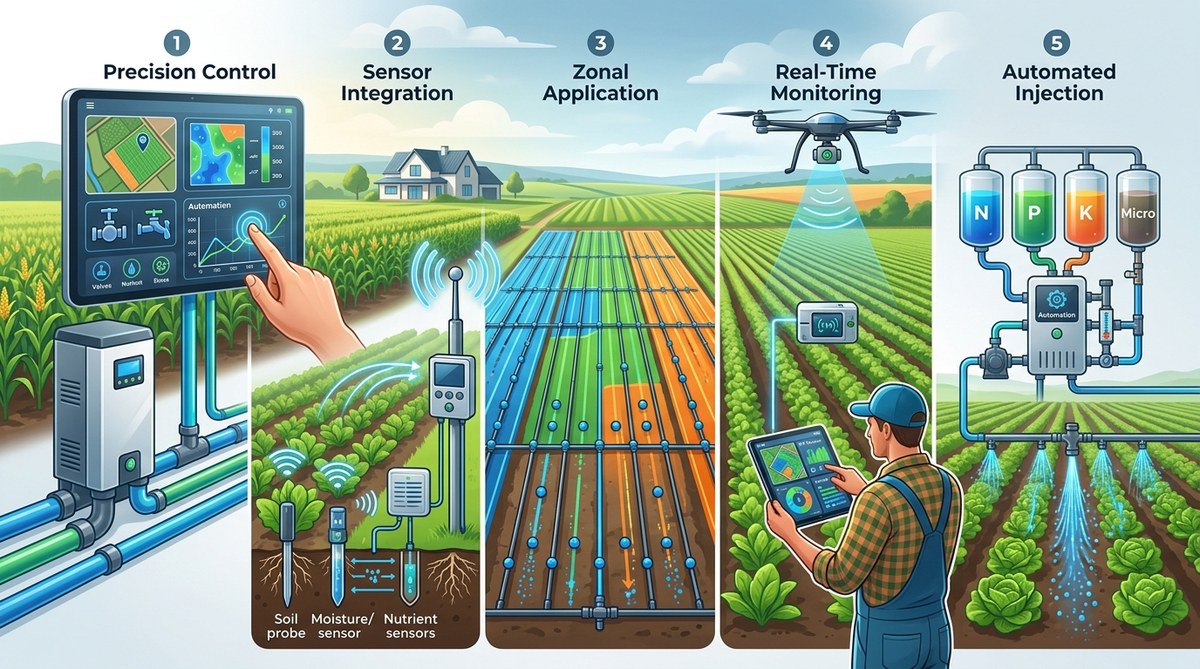
You are standing in a corn field in central Illinois. On one side, the plants are tall and dark green. On the other side, just a few rows over, the stalks are shorter and pale. The soil is different there. The nutrient needs are different. But your old irrigation system treats both sides the same. That is the problem variable rate fertigation systems are built to solve. Instead of applying one uniform mix of water and fertilizer across an entire field, these systems adjust the recipe in real time. They match the exact nutrient needs of each management zone. For precision agriculture specialists and agronomists, this is the difference between guessing and knowing. In 2026, the technology has matured enough that any large scale grower can justify the investment.
Variable rate fertigation systems let you apply the right amount of nitrogen, phosphorus, and potassium to each part of a field based on real time sensor data and soil maps. This guide covers five automation strategies, common mistakes to avoid, and the hardware setup you need to start saving on input costs this season.
How Variable Rate Fertigation Systems Work
At its core, a variable rate fertigation system combines three things: a way to measure what the crop needs, a controller that decides how much to apply, and hardware that changes the injection rate on the fly. The magic happens when these three parts talk to each other without a person standing at a valve.
Most systems in use today rely on a prescription map. You create that map from soil samples, yield data, or drone imagery. The controller reads the map as the irrigator moves across the field. It then adjusts the injection pump speed or opens different manifold valves to match the target rate for that specific zone.
The result is simple. You stop over applying nitrogen on sandy knolls where it leaches away. You stop under applying on heavy clay spots where roots struggle. Every drop of fertilizer goes where it can do the most good.
Five Ways to Automate Nutrient Delivery
Here are the five most effective methods for automating nutrient delivery with variable rate fertigation systems in 2026. Each one fits a different operation size and budget.
-
Sensor based real time adjustment. This method uses in ground sensors to measure nitrate, potassium, and moisture levels continuously. The controller reads the sensor data every few minutes and adjusts the injection rate to maintain a target concentration in the root zone. It works best for high value crops like vegetables or almonds where every pound of yield matters.
-
Prescription map driven control. You upload a predefined map to the controller. The map divides the field into zones based on soil type, organic matter, or past yield. As the pivot or drip system moves, the controller matches the fertilizer rate to the zone. This is the most common approach for row crops like corn and soybeans.
-
Weather responsive automation. The system pulls data from a local weather station or an API. If rain is forecast, the controller reduces nitrogen application to prevent leaching. If a heat wave is coming, it adjusts potassium to help with stress tolerance. This method pairs well with any of the others.
-
Flow based proportional injection. A flow meter measures the irrigation water volume. The controller injects fertilizer at a rate that keeps the concentration constant or varies it according to the prescription. This is a simpler approach that works well on older pivot systems that lack variable speed drives.
-
Multi tank blending. Instead of one fertilizer tank, you have three or four. The controller blends them in different ratios as the system moves across zones. This lets you change the N P K ratio on the fly. It is the most flexible option but requires more hardware and calibration.
Common Mistakes to Avoid
Even the best variable rate fertigation systems will fail if you skip the basics. Here are the most frequent mistakes I see on farms across the Midwest and the right way to handle each one.
| Mistake | Why It Hurts | The Fix |
|---|---|---|
| Using old soil maps | Zones shift over time. A map from three years ago is wrong. | Resample every two years or use drone imagery to update zones annually. |
| Ignoring water chemistry | Calcium in hard water can lock up phosphorus in the injection line. | Test your source water and adjust your fertilizer blend to avoid precipitation. |
| Skipping calibration | Injection pumps drift. A 10% error means wasted money. | Calibrate every 30 days. Use a bucket and a stopwatch. |
| Running the system too fast | High injection rates cause poor mixing in the main line. | Keep injection below 10% of the mainline flow rate. |
| Forgetting to flush | Fertilizer residue builds up and clogs emitters. | Flush the system with clean water for 15 minutes after each fertigation event. |
Hardware You Need to Get Started
You do not need a million dollar retrofit to run variable rate fertigation systems. Most modern pivots and drip systems can be upgraded with a few key components.
- A variable frequency drive on the injection pump. This lets you change the flow rate electronically instead of turning a manual valve.
- A flow meter on the main water line. You need to know how much water is moving to calculate the right injection ratio.
- A controller with GPS. The controller needs to know where it is in the field to apply the correct rate from the prescription map.
- Check valves and backflow prevention. This is not optional. You must protect your water source from fertilizer contamination.
- In ground or in line sensors. These give you the real time feedback loop that makes automation work. Without them, you are just running a timer.
For a deeper look at how sensors fit into your overall farm network, read our guide on implementing digital soil sensors to boost crop health and productivity.
The Data Pipeline That Makes It Possible
A variable rate fertigation system is only as good as the data that feeds it. You need a reliable pipeline from the field to the controller and back again.
Start with soil sampling. Grid sampling or zone sampling gives you the baseline. Then layer on yield data from the combine. In 2026, most growers also use multispectral drone imagery to spot in season variability. That imagery can be converted into a nitrogen prescription map in under 24 hours.
The controller needs to receive that map. Some systems use a USB drive. Better systems use cloud based software that syncs automatically. If your farm already uses a platform for harnessing iot devices to transform modern farming practices, make sure your fertigation controller is compatible.
Once the data is in the controller, the system runs autonomously. But you still need to monitor it. Set up alerts for low tank levels, pump failures, and unexpected rate changes. A text message that says “Zone 3 nitrogen rate dropped below target” can save you from a costly mistake.
When to Use Each Automation Strategy
Not every method fits every crop. Here is a simple way to think about it.
- Row crops like corn and soybeans benefit most from prescription map driven control. The variability is consistent year to year.
- High value vegetables and specialty crops need sensor based real time adjustment. The margin for error is smaller.
- Alfalfa and permanent pastures do well with weather responsive automation. The main goal is avoiding leaching during rain events.
- Orchards and vineyards need multi tank blending. The nutrient demand changes dramatically between fruit set and harvest.
If you are still unsure which approach fits your operation, start with the simplest one. Flow based proportional injection with a single fertilizer tank is easy to install and troubleshoot. You can add complexity later as you get comfortable.
“The growers who succeed with variable rate fertigation are the ones who treat it as a system, not a gadget. They calibrate their sensors, update their maps, and flush their lines. The technology is reliable, but it still needs a good operator.” — Tom G., precision ag specialist in eastern Nebraska.
A Step by Step Plan for This Season
You can implement variable rate fertigation systems on your farm in one growing season. Here is a realistic timeline.
- Winter months. Pull your soil samples. Create a preliminary zone map using yield data and elevation layers. Order your controller and injection hardware.
- Early spring. Install the hardware. Calibrate the injection pump. Run a test with clean water to check for leaks and mixing uniformity.
- Pre planting. Upload your prescription map. Set your target rates for each zone. Run the system on a small test block to verify the output matches the map.
- In season. Monitor the sensor data weekly. Adjust the prescription if you see stress in the drone imagery. Flush the system after every fertigation event.
- Post harvest. Download the as applied map. Compare it to your yield map. Use that information to build a better prescription for next year.
For a broader view of how data analytics can improve your entire operation, check out our article on top strategies for using data analytics to maximize crop yields.
Measuring Your Return on Investment
The question every grower asks is whether the system pays for itself. The answer depends on your current fertilizer costs and how much variability your fields have.
A typical variable rate fertigation system for a 500 acre pivot costs between $8,000 and $15,000 for the controller, pump drive, and sensors. The ongoing cost is your time for calibration and map updates.
The savings come from two places. First, you reduce total fertilizer use by 10 to 20 percent because you stop over applying in low yielding zones. Second, you increase yield in the zones that were previously under fertilized. Combined, these gains often pay for the system in the first two seasons.
If you are growing corn at $5 per bushel and applying 200 pounds of nitrogen per acre, a 15 percent reduction in nitrogen on 500 acres saves you roughly $3,000 per year. Add in a 5 percent yield bump on the underperforming zones, and the payback period drops under two years.
Putting It All Together for 2026
Variable rate fertigation systems are no longer experimental. They are a proven tool for cutting input costs and improving yields across a wide range of crops and regions. The hardware is reliable. The software is user friendly. The data pipeline from soil sample to controller is smoother than ever.
Start small if you need to. Pick one pivot or one field. Install the hardware. Run it for a season. Learn what works for your soil types and your crop rotation. Then scale up. The technology is ready. Your operation is ready. The only thing left is to make the first move.
If you want to see how this fits into a fully automated farm, take a look at our guide on 7 steps to building a fully integrated smart farm system. The future of farming is not about working harder. It is about working smarter with data and automation. Variable rate fertigation is one of the best places to start.
