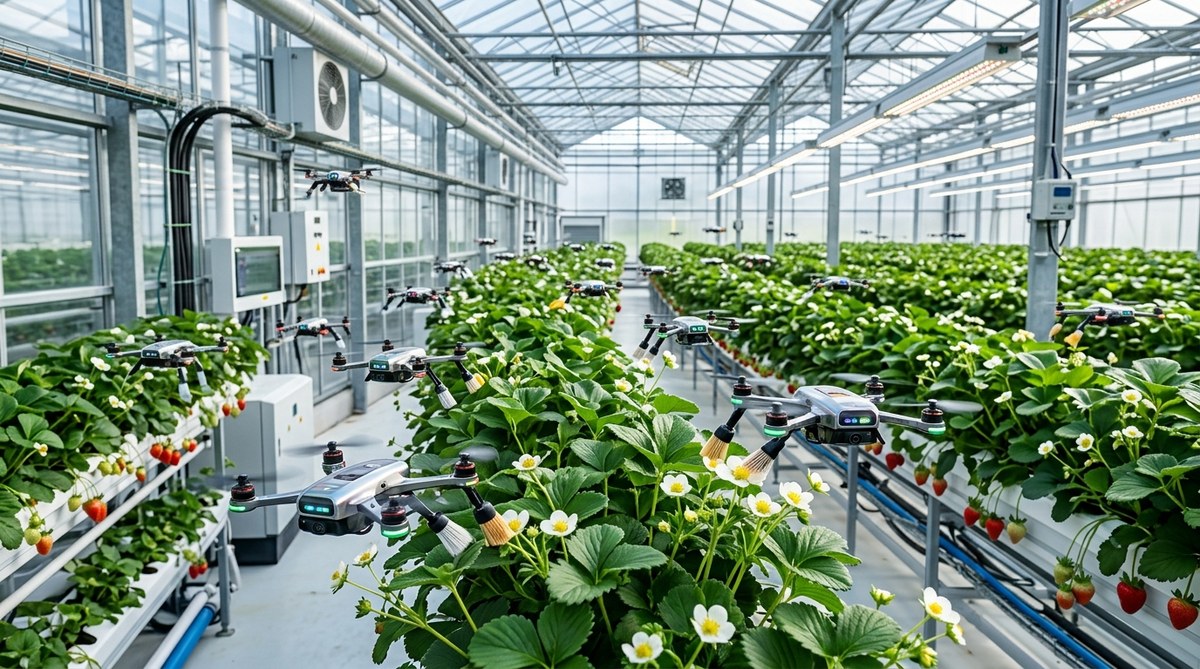
Picture a greenhouse where hundreds of tiny robots move like a flock of birds. They zip from flower to flower, each one carrying a payload of pollen. No buzzing bees. No hired labor with hand wands. Just a coordinated team of machines working in perfect sync. This is the reality of swarm robotics for greenhouse pollination, and it is changing how we grow food under cover.
Swarm robotics uses many small, simple robots that communicate with each other to pollinate every plant in a high-tech greenhouse. This method cuts labor costs, removes dependence on declining natural pollinators, and boosts fruit set rates by up to 30 percent. For precision ag engineers, the key is pairing the right robot design with a smart control system that maps bloom cycles in real time.
How Swarm Robotics Solves the Pollination Problem
Natural pollinators like bumblebees are struggling. Colony collapse, pesticide exposure, and climate shifts have made them unreliable for commercial greenhouses. Hand pollination, meanwhile, is expensive and hard to scale. A single acre of tomatoes can require dozens of workers with vibrating wands, and the results vary with each person’s technique.
Swarm robotics addresses both issues at once. Instead of one giant machine, you deploy a fleet of small robots. Each unit is cheap to build. If one breaks, the rest keep working. The swarm covers every row, every plant, every flower. No gaps. No missed blooms.
“The beauty of a swarm is that it does not need a central brain. Each robot follows simple rules, and together they achieve complex coverage. This is the same principle that lets ants find food or starlings form murmurations.” — Dr. Elena Marchese, precision robotics researcher at Cornell AgriTech
The Core Components of a Pollination Swarm
Before you buy any hardware, you need to understand what makes a swarm tick. Here are the essential pieces.
- Robot body and drive system: Most designs use a lightweight chassis with wheels or small treads. Some models fly, but ground-based robots are safer around delicate blossoms and use less power.
- Pollen transfer mechanism: Common approaches include a soft brush, an electrostatic wand, or a tiny air puff. The goal is to mimic the gentle touch of a bee without damaging the flower.
- Onboard sensors: Each robot carries a camera and sometimes a lidar unit. These sensors identify open flowers, measure their maturity, and check for disease.
- Communication module: Robots talk to each other using a mesh network. They share data on which areas have been pollinated, so the swarm avoids wasting time on already visited blooms.
- Central dashboard: A software platform aggregates data from the entire swarm. You can see coverage maps, bloom forecasts, and robot battery levels from a tablet or phone.
Setting Up Your Swarm in Six Steps
Getting started with swarm robotics does not require a complete greenhouse overhaul. Follow this numbered process to integrate a pollination swarm into your existing operation.
-
Map your greenhouse layout. Use the central dashboard to draw your bench and row boundaries. Include obstacles like support posts and irrigation lines. The swarm needs this map to plan efficient routes.
-
Calibrate the bloom detection model. Each robot’s camera feeds into a machine learning model that recognizes open flowers. You will need to train it on your specific crop. For example, tomato flowers look different from strawberry blossoms. Most modern systems include a pre-trained model for common greenhouse crops, but you should run a validation pass with your own images.
-
Set the pollination schedule. Decide how many times per day the swarm should run. For most fruiting crops, one to three passes per day is enough. The system can adjust automatically based on bloom density.
-
Define no-go zones. Mark areas where robots should not travel, such as wet floors after irrigation or sections with active workers. The swarm respects these boundaries.
-
Run a dry test. Let the robots move through the greenhouse without activating the pollen transfer mechanism. Watch for collisions, missed turns, or areas the swarm skips. Tweak the navigation parameters until coverage is complete.
-
Go live and monitor. Activate pollination mode. Check the dashboard after the first day. Look for coverage gaps and robot battery levels. Fine tune the swarm size. You might find that 20 robots do the work of 30 once the software learns the optimal paths.
Comparing Pollination Methods: A Side by Side Look
The table below breaks down the main differences between manual pollination, natural pollinators, and swarm robotics.
| Method | Labor Cost per Acre per Season | Fruit Set Rate | Reliability | Scalability |
|---|---|---|---|---|
| Hand pollination (wand) | $8,000 to $12,000 | 75 to 85 percent | Low (depends on worker skill) | Hard to scale |
| Natural pollinators (bumblebees) | $2,500 to $4,000 | 80 to 90 percent | Medium (bee health varies) | Moderate (hives needed per zone) |
| Swarm robotics | $3,000 to $5,000 (equipment amortized) | 88 to 95 percent | High (robots run 24/7) | Easy to scale (add more robots) |
The numbers show that swarm robotics matches or beats the competition on every metric. The upfront investment is higher than buying bumblebee hives, but the robots last for years and never get sick.
Common Mistakes and How to Avoid Them
Swarm robotics is not a plug and play solution. Here are the pitfalls that greenhouse managers often face.
- Skipping the calibration step. If the robot cannot tell a flower from a leaf, it will waste battery and time. Spend a full day training and testing the vision model before you go live.
- Using too many robots. A swarm of 50 robots in a small greenhouse causes traffic jams. Start with a small number and add more only if coverage gaps appear.
- Ignoring the communication network. Robots that lose signal become lost. Install mesh repeaters in large greenhouses, especially near metal structures that block radio waves.
- Forgetting to clean the pollen brushes. Pollen builds up and clogs the transfer mechanism. Build a daily cleaning routine into your standard operating procedures.
- Treating it as a set and forget system. The bloom cycle changes with the season. Review the dashboard weekly and adjust the schedule as needed.
Integrating Swarm Data with Your Farm Management System
A pollination swarm generates a lot of data. Each robot logs its path, the number of flowers pollinated, and the time spent per zone. This information is valuable for broader crop management.
You can feed the data into your existing analytics platform to spot trends. For example, if a certain section of the greenhouse consistently shows lower pollination rates, it might indicate a microclimate issue or a nutrient deficiency. The swarm becomes a sensor network as much as a labor replacement.
Consider connecting the swarm to your to get a full picture of your operation. The pollination data combined with soil sensor readings and climate controls gives you an unprecedented view of plant health.
Matching Robot Type to Crop
Not all crops need the same pollination technique. Here is a guide for choosing the right robot design.
| Crop | Best Robot Type | Notes |
|---|---|---|
| Tomatoes | Ground rover with vibrating wand | Flowers are sturdy and hang downward |
| Strawberries | Ground rover with soft brush | Flowers are low and fragile |
| Peppers | Ground rover with electrostatic puff | Flowers are small and hidden |
| Cucumbers | Flying drone with air puff | Flowers are high and spread out |
| Eggplant | Ground rover with vibrating wand | Similar to tomato flowers |
Ground rovers work for most greenhouse crops. Flying drones are best for tall vine crops where ground access is limited. The trade off is that drones use more power and require more safety protocols.
The Future of Swarm Pollination in 2026 and Beyond
We are seeing three major trends this year. First, robot prices are dropping. A basic pollination rover now costs about the same as a high end tractor tire. Second, the software is getting smarter. New models can predict bloom peaks two days in advance and adjust the swarm schedule automatically. Third, interoperability is improving. Most swarms now speak the same data language as climate control systems and irrigation controllers.
If you are building a new high-tech greenhouse, consider including a dedicated charging station and a robot garage in your floor plan. This makes scaling up much easier later.
For existing greenhouses, the best approach is to start with a pilot. Rent or buy a small swarm for one bay. Run it for a full growing cycle. Measure the fruit set improvement and the labor hours saved. Use that data to justify a full rollout.
Making the Switch to Automated Pollination
The technology is ready. The cost is reasonable. The benefits are proven. Swarm robotics for greenhouse pollination is no longer a research project. It is a practical tool that can improve your yield, reduce your risk, and free your team for higher value tasks.
Start by talking to other growers who have made the switch. Visit a greenhouse that uses swarms. Ask about their ROI and their biggest lessons learned. Then run your own pilot. You will likely find that the swarm pays for itself within two seasons.
The next step is to look at how other automation tools can complement your new swarm. For example, can work alongside your pollination robots to create a fully automated growing cycle. And can help you make sense of all the data your swarm collects.
The greenhouse of 2026 runs on data, automation, and smart systems. Swarm robotics is a key piece of that puzzle. Give it a try. Your plants, your wallet, and your workers will thank you.
