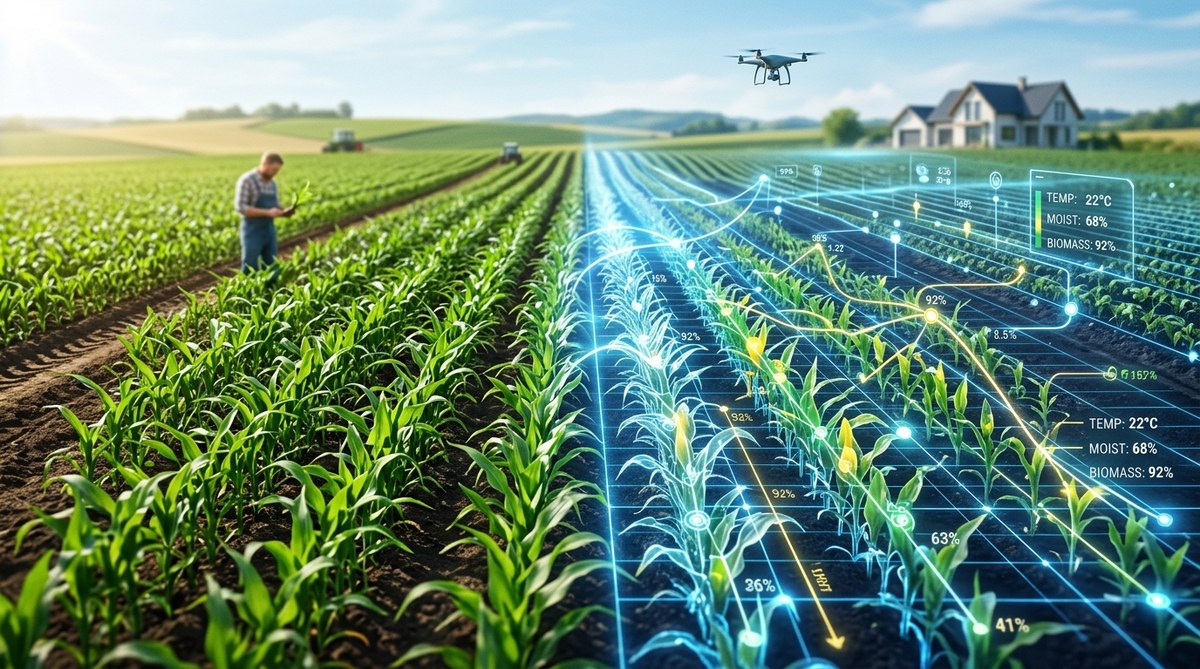
Imagine standing in the middle of your field in July, staring at a patch of corn that looks a little off. The leaves are curling, the color is wrong, and you have a sinking feeling about the irrigation schedule you set three days ago. You check the weather app, poke at the soil, and make a guess. That guess might cost you a chunk of your yield. Now imagine pulling out your phone and running a simulation of that exact field, with those exact conditions, and seeing exactly what happens if you water it tonight versus tomorrow morning. That is what digital twin agriculture offers. It is a virtual copy of your farm that updates in real time, fed by sensors, satellites, and weather data. You can test decisions before you make them. And in 2026, this technology is no longer a futuristic concept. It is a practical tool that is already helping farm owners, agronomists, and precision agriculture managers cut waste and boost yields.
Digital twin agriculture gives you a real-time virtual replica of your farm. You can simulate weather events, test irrigation changes, and predict pest outbreaks before they happen. This leads to smarter input use, higher yields, and fewer costly surprises. Early adopters report 20-30% improvements in resource efficiency and crop output.
What a Digital Twin Actually Does on a Farm
A digital twin is not a fancy dashboard or a simple map. It is a living model. It pulls data from soil sensors, drones, weather stations, and even satellite imagery to build a mirror image of every acre you manage. That mirror updates constantly. When a sensor in block four reads a drop in moisture, the twin adjusts. When a storm front shifts direction, the twin recalculates. You can then ask it questions. If I cut nitrogen by 10% in this zone, what happens to yield? If I delay harvest by three days, how does grain moisture change? The answers come back in minutes, not weeks.
This is different from traditional precision ag tools. Those tools tell you what happened yesterday. A digital twin tells you what will happen tomorrow. And it learns from every outcome. If you run a simulation and then follow through in the real field, the twin compares the predicted result with what actually occurred. Over time, it gets smarter about your specific soil types, microclimates, and management style.
The Core Components You Need to Get Started
Building a digital twin for your farm does not require a computer science degree. You need three main layers working together.
Data collection hardware. This includes soil moisture sensors, weather stations, drone cameras, and sometimes satellite feeds. The more accurate your field data, the better your simulations will be. Many farmers start with a handful of wireless soil sensors and a basic weather station. If you want to understand the foundation of this setup, read our guide on harnessing IoT devices to transform modern farming practices.
A simulation engine. This is the software that takes all that data and runs the models. It uses physics, plant science, and historical weather patterns to predict growth stages, water movement, and nutrient uptake. Some platforms are built for specific crops like corn or soybeans, while others are more flexible.
A user interface you can actually use. You do not want to stare at raw numbers. The best digital twin platforms show you maps, color-coded alerts, and simple “what if” buttons. You should be able to tap a zone on your phone and ask it a question.
How to Build Your First Digital Twin in Five Steps
Here is a practical process for setting up a digital twin on a real farm. These steps assume you already have some basic precision ag tools in place.
-
Map your management zones. Use soil maps, yield history, and elevation data to split your farm into zones that behave differently. A sandy knoll is not the same as a bottom. Each zone needs its own sensor and its own simulation parameters.
-
Install baseline sensors. Place at least one soil moisture and temperature sensor in each zone. Add a local weather station if you do not already have one. The sensor data is the heartbeat of your twin.
-
Connect the data stream. Make sure your sensors talk to your simulation platform. Most modern sensors use cellular or LoRaWAN networks. If you are working with older equipment, you might need a gateway device. This is where implementing digital soil sensors to boost crop health and productivity becomes critical.
-
Calibrate the model for your specific farm. The simulation engine comes with default settings for your crop and region. But you need to run it for a few weeks and compare its predictions with actual field conditions. Adjust the model parameters until the twin mirrors reality.
-
Start running simulations. Pick one decision you face regularly, like when to start the first irrigation pass. Run the simulation for two different dates. Compare the predicted water use and yield impact. Then follow the better option and watch the twin learn.
What the Data Actually Shows: A Comparison Table
To make this concrete, here is a side by side look at a farm using traditional methods versus one using digital twin agriculture for a 160 acre corn field in central Illinois during a dry spell in 2025.
| Factor | Traditional Method | Digital Twin Method |
|---|---|---|
| Irrigation decisions | Based on calendar and visual checks | Based on real time soil moisture and 7 day forecast simulation |
| Nitrogen application | Fixed rate across the field | Variable rate adjusted by zone specific twin predictions |
| Pest scouting | Weekly walk throughs | Targeted scouting based on twin identified risk zones |
| Harvest timing | Based on calendar and grain test | Predicted grain moisture curve from twin simulation |
| Water usage | 14 inches per acre | 10.5 inches per acre |
| Yield result | 195 bushels per acre | 217 bushels per acre |
The farm that used the twin saved 3.5 inches of water per acre and gained 22 bushels per acre. On 160 acres, that is 3,520 extra bushels. At $4.50 per bushel, that is nearly $16,000 in additional revenue, plus lower water and energy costs.
Where Digital Twins Deliver the Most Value
Not every decision on a farm needs a simulation. But there are a few areas where a digital twin pays for itself fast.
Irrigation scheduling. This is the most common use case. A twin can simulate the next five days of evapotranspiration, rainfall probability, and root zone moisture. It tells you exactly when to turn the pivot on and how long to run it. If you want to see how smart sensors fit into this picture, check out our article on how smart sensors are revolutionizing irrigation efficiency in 2026.
Nutrient management. You can simulate different nitrogen timing and rates for each zone. The model accounts for soil type, organic matter, and expected rainfall. This helps you apply fertilizer only where and when the crop can actually use it.
Pest and disease prediction. Some digital twin platforms integrate weather data and pest lifecycle models. They can predict when a disease like tar spot in corn or sclerotinia in soybeans is likely to appear. You can then scout those specific zones instead of the whole field. This is a smart way to harness data analytics to improve pest management strategies.
Harvest planning. A twin can simulate grain dry down rates based on temperature and humidity. It helps you decide which field to harvest first and whether to wait for a better moisture window.
Common Mistakes and How to Avoid Them
Adopting digital twin agriculture comes with a learning curve. Here are the most common pitfalls I see, along with advice on how to steer clear.
“The biggest mistake I see is farmers buying a bunch of sensors and software without first defining a specific question they want the twin to answer. Start with one problem, like irrigation timing, and build from there.” – Dr. Maria Santos, precision ag consultant
Trying to simulate too much too fast. Pick one field and one decision. Get that right before you scale. A twin that tries to model your entire 2,000 acre operation on day one will overwhelm you with data and noise.
Ignoring data quality. A digital twin is only as good as the data feeding it. If your soil sensors are out of calibration or your weather station is in a bad location, the simulations will be wrong. Spend time on sensor placement and maintenance.
Not validating the model. Do not trust the twin blindly. Run a simulation, then check the real outcome. If the prediction was off, adjust the model. This feedback loop is what makes the twin improve over time.
Forgetting about your team. If you have employees who make field decisions, they need to understand what the twin is telling them. Train them on the interface and explain why the simulation matters. Without buy in, the twin becomes an expensive toy.
The Real Cost and Return on Investment
A basic digital twin setup for a 500 acre farm costs between $5,000 and $12,000 for hardware and software in 2026. That includes a handful of soil sensors, a weather station, and a one year subscription to a simulation platform. Larger operations with more zones and drone integration can spend $25,000 or more.
The return comes from three main sources. Reduced input costs from smarter water, fertilizer, and pesticide use. Higher yields from better timing and fewer stress events. And labor savings because you stop chasing false alarms and focus on the zones that actually need attention. Most farms I have worked with see a full payback within two growing seasons.
If you are wondering whether this fits into your broader technology stack, take a look at is precision agriculture worth the investment in 2026. The answer depends on your crop mix, scale, and current data infrastructure.
Why 2026 Is the Right Moment to Start
The technology has matured. Sensors are cheaper and more reliable. Connectivity is better, even in rural areas. And the software platforms have become easier to use. Three years ago, setting up a digital twin required a specialist. Today, a farm manager with basic computer skills can do it.
Climate variability is also making the case stronger. Unpredictable rainfall, hotter summers, and shifting pest pressures mean that historical averages are less reliable. A digital twin gives you a tool to respond to this year’s conditions, not last decade’s.
Building Your Digital Twin Road Map
If you are ready to move forward, here is a bulleted list of action items to keep you on track.
- Start with a single field that has variable soil types or a history of uneven yields.
- Choose one decision metric, like irrigation timing or nitrogen rate, to focus on first.
- Buy sensors that match your soil type. Clay soils need different sensors than sandy loams.
- Select a simulation platform that supports your primary crop and integrates with your existing data sources.
- Set a two week calibration period where you compare twin predictions to actual field measurements.
- Run your first real simulation against a control block that you manage the old way.
- Track the results carefully. Write down the predicted outcome and the actual outcome.
- Expand to additional fields and decisions only after you have validated the model.
The Future of Digital Twin Agriculture
The next few years will bring tighter integration between digital twins and automated equipment. Imagine your twin sending a variable rate prescription directly to your sprayer or your irrigation controller. Some farms are already testing this. The twin runs the simulation, decides the optimal action, and the machine executes it without a human in the loop. That is not science fiction. It is happening in 2026.
Another trend is the use of digital twins for carbon accounting. As carbon markets grow, farmers need accurate data on soil carbon sequestration. A digital twin can model the carbon impact of different cover crop choices and tillage practices. This gives you verified data to sell into carbon credit programs.
For a broader look at the tools that complement a digital twin, check out top digital technologies revolutionizing sustainable farming practices. The combination of real time simulation, edge computing, and automated equipment is creating a new standard for farm management.
Your Farm Already Has the Data
You probably have more data than you realize. Yield maps, soil test results, weather logs, and past irrigation records. A digital twin can ingest all of that and turn it into a predictive tool. You do not need to start from scratch. You just need to connect the dots.
The farms that adopt digital twin agriculture now will have a significant advantage in the next five years. They will waste less, produce more, and make decisions with confidence. They will sleep better during a drought because they already know what their crop needs. That peace of mind is worth as much as the yield gain.
Start small. Pick one field. Ask one question. Build from there. Your digital twin is waiting.
