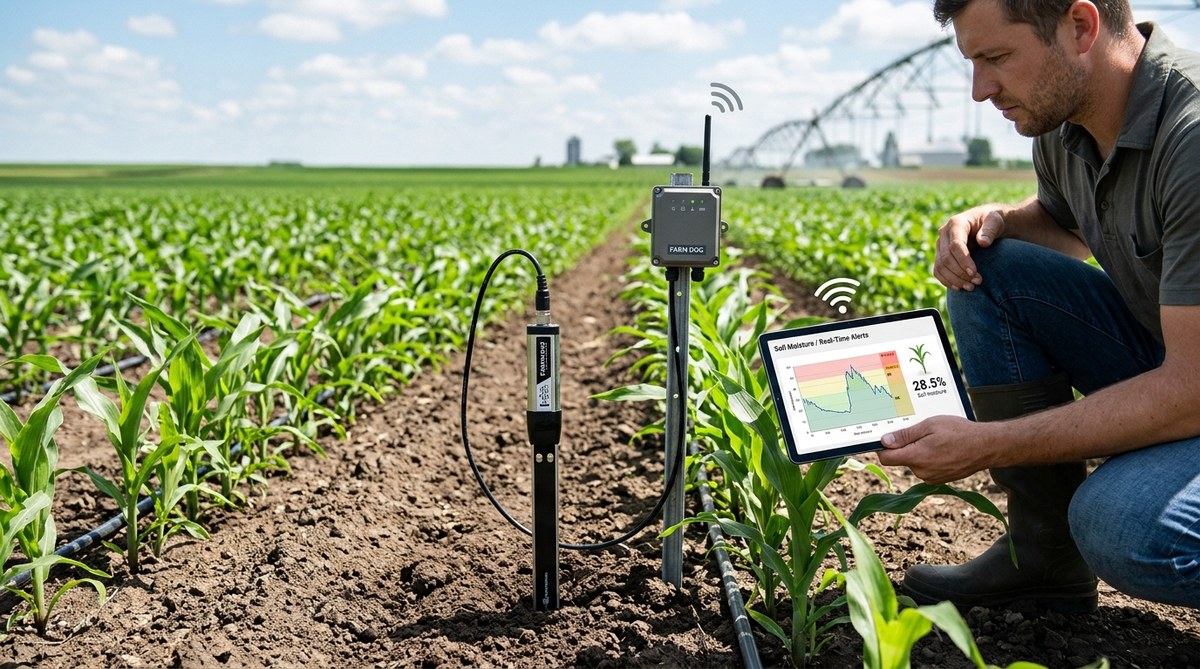
You walk into the field and see the crop wilting. You check the irrigation logs. The system ran last night. But the soil is already dry. That lag between what you see and what the plant feels is costing you yield. Soil moisture capacitance sensor real-time alerts close that gap. Instead of checking once a day or relying on a fixed timer, you get a notification the moment the root zone crosses a stress threshold. This guide shows you how to set up that alert system, interpret the data, and avoid the common mistakes that make sensors useless.
Capacitance sensors measure the dielectric permittivity of the soil, which correlates directly to water content. To get reliable real-time water stress alerts, you must install sensors at the correct depth, calibrate for your specific soil type, and set threshold alarms that match the crop’s growth stage. A well-tuned alert system can reduce water use by 25 to 35 percent while preventing yield loss from hidden drought stress.
What Makes a Capacitance Sensor Different
Not all soil moisture sensors work the same way. Capacitance sensors use an oscillator circuit to measure the dielectric constant of the soil. Water has a high dielectric constant compared to air and mineral particles. When the soil is wet, the sensor reads a higher frequency shift. When it is dry, the shift is smaller.
This is different from resistance-based sensors, which measure electrical conductivity. Resistance sensors can drift over time because salts in the soil build up on the electrodes. Capacitance sensors are less sensitive to salinity, which makes them a better choice for fields with variable fertilizer applications or recycled water.
The output from a capacitance sensor is usually a raw value or a volumetric water content percentage. Most modern sensors output data in millivolts or a scaled percentage. You take that number and compare it to your field specific calibration curve to get the actual moisture level.
How Real-Time Alerts Prevent Water Stress
A real-time alert is not just a dashboard that shows a number. It is a push notification that tells you a specific zone has dropped below a safety threshold. This matters because water stress in crops like corn, soybeans, or almonds can cause irreversible yield loss within 48 hours during critical growth stages.
The alert system works like this:
- The sensor takes a reading every 5 to 15 minutes.
- The data travels over a wireless network to a cloud platform or local edge computer.
- The software compares the reading against a threshold you set.
- If the reading falls below the threshold, the system sends you an alert via SMS, email, or an app notification.
You set the threshold based on the crop’s stress point. For example, corn at the V12 stage starts showing yield drag when volumetric water content drops below 30 percent in the top 12 inches. If your sensor reads 28 percent, you get an alert that says “Zone 3 West: moisture at 28 percent, below V12 threshold.”
Installing Sensors for Reliable Readings
Placement is everything. A sensor installed in the wrong spot will give you alerts that are either too early or too late. Here is the process we recommend for field scale installations:
- Choose representative locations. Do not put the sensor at the edge of the field or near a low spot where water pools. Pick a spot that represents the average soil type and drainage for that zone.
- Install at the correct depth. For most row crops, you need sensors at two depths: one at 4 to 6 inches to track the active root zone, and one at 12 to 18 inches to monitor deep percolation and subsoil moisture.
- Use a soil probe or auger to make a clean hole. Do not just push the sensor into the ground. That creates air gaps around the prongs, which cause false low readings.
- Pack the soil back around the sensor firmly. Air pockets will give you erratic data.
For permanent installations, bury the sensor horizontally at the target depth. This gives you a consistent reading across the sensor face and reduces the effect of preferential water flow down the side of the probe.
Setting Thresholds That Actually Work
The most common failure in real-time alert systems is bad thresholds. People set the alarm too tight or too loose. If your alert goes off every afternoon because the surface dried out, you will ignore it. If it only goes off when the crop is already wilted, you lost the yield before you got the message.
Here is a practical way to set your thresholds:
| Crop Stage | Alert Trigger (Volumetric Water Content) | Action |
|---|---|---|
| Seedling establishment | Below 35% at 4 inches | Start light irrigation within 2 hours |
| Vegetative growth | Below 30% at 8 inches | Start irrigation within 4 hours |
| Flowering or grain fill | Below 40% at 8 inches | Start irrigation immediately |
| Maturation | Below 25% at 12 inches | Start irrigation within 12 hours |
These numbers are starting points. You need to adjust them for your soil texture. Sandy soils hold less water and drain faster, so your thresholds should be higher. Clay soils hold more water but release it slowly, so your thresholds can be lower.
“The biggest mistake I see is using a single threshold all season. Crops need different moisture levels at different stages. A sensor that says 30 percent at tasseling is a crisis. At maturity, it is fine. You have to change the alert parameters as the crop grows.” — Dr. Laura Mendez, precision agronomist, University of Nebraska.
Building the Alert Pipeline
The sensor by itself does nothing. You need a data pipeline to turn the raw readings into alerts. Here is the typical architecture for a farm scale system:
-
Sensor nodes: Each sensor connects to a data logger or a wireless transmitter. LoRaWAN is the most common protocol for field sensors because it has long range and low power draw. A set of AA batteries can run a LoRaWAN sensor for a full season.
-
Gateway: One gateway can cover hundreds of acres. It collects data from all the sensors in the field and sends it to the cloud over a cellular or satellite link.
-
Cloud platform or edge computer: This is where the logic lives. You can use a commercial platform like FarmDog or a custom dashboard built on AWS or Azure. The platform stores the data, applies your threshold rules, and triggers alerts.
-
Alert delivery: SMS is still the most reliable for fields with spotty internet. Email and push notifications are good backups. Some platforms also integrate with irrigation controllers so the system can start or stop water automatically.
If you want to keep the data processing local, set up an edge computer at the field edge. This reduces latency and works even if the internet goes down. Edge computing is becoming more common in 2026 because it gives you real-time control without depending on a cloud connection.
Common Mistakes and How to Avoid Them
Even experienced technicians make these errors. Here is a table that shows the most common problems and the fixes.
| Mistake | What Happens | Fix |
|---|---|---|
| Installing too shallow | Sensor reads surface evaporation, not root zone moisture | Bury the sensor at the crop specific root depth |
| Not calibrating for soil type | Raw readings are off by 10 to 15 percent | Run a gravimetric calibration for your field |
| Using a single threshold all season | Alerts trigger at the wrong time | Adjust thresholds for each growth stage |
| Ignoring temperature effects | Sensor drifts on hot days | Use sensors with built-in temperature compensation |
| Placing sensors in wheel tracks | Soil is compacted; readings are artificially high | Install sensors in the row, not in the traffic lane |
Integrating Alerts with Your Irrigation System
The real power of soil moisture capacitance sensor real-time alerts comes when you close the loop. Instead of just getting a notification and then walking to a valve, you can automate the response.
Many modern irrigation controllers accept a digital input from a sensor platform. When the alert triggers, the controller can start a prescribed irrigation cycle for that zone. When the sensor reads that the moisture has returned to the target level, the controller can shut off.
This is called variable rate irrigation based on real-time feedback. It is the most water efficient method available in 2026. If you are already using IoT devices on your farm, you can connect your sensor alerts to a broader system that also factors in weather forecasts and crop growth models. For a deeper look at how these devices work together, see our guide on harnessing IoT devices to transform modern farming practices.
Tuning Alerts for Different Crop Types
Not all crops stress at the same moisture level. Here are some guidelines for common crops grown in the United States:
- Corn: The critical window is from V10 to R2. Keep volumetric water content above 30 percent at 8 inches. Below that, you lose kernel count.
- Soybeans: Flowering and pod fill are the most sensitive stages. Keep moisture above 35 percent in the top 6 inches.
- Cotton: Boll development needs consistent moisture. Set your alert at 40 percent in the top 12 inches. Cotton can handle a drydown at maturity, but not during bloom.
- Almonds: The root zone is deep. Monitor at 18 and 36 inches. Set alerts at 25 percent in the deep zone. Shallow alerts are less useful because the roots are deep.
- Tomatoes: Shallow rooted and sensitive. Keep moisture above 45 percent at 4 inches. Any drop below that during fruit set will reduce size.
A Step-by-Step Workflow for Your First Season
If you are setting up soil moisture capacitance sensor real-time alerts for the first time, follow this sequence.
- Map your field into management zones based on soil type and topography.
- Install one sensor pair per zone. Place them at the correct depths for your crop.
- Run the sensors for one week without any alerts. Collect baseline data.
- Take hand samples from the same spots and dry them in an oven to get the actual gravimetric water content.
- Compare the sensor readings to the hand samples. Build a calibration curve for each soil type.
- Set your initial thresholds based on the crop stage table above.
- Configure the alert delivery method. Start with SMS because it is the most direct.
- Watch the alerts for two weeks. If you get false alarms, adjust the thresholds.
- At the next crop stage, update the thresholds.
This workflow takes time upfront, but it saves you from chasing bad data all season.
Making the Data Useful for Your Team
A single alert is useful. A pattern of alerts over time is powerful. After a few weeks, you will start to see which zones dry out first, how fast the soil loses moisture after an irrigation event, and whether your current irrigation schedule is keeping up.
Share this data with your irrigation manager or agronomist. Set up a weekly review where you look at the alert log and adjust the next week’s irrigation plan. Over time, you will build a library of field specific knowledge that makes your alerts more accurate each season.
If you want to combine your sensor data with weather forecasts for even tighter scheduling, read our guide on how to combine soil sensors and weather APIs for precision irrigation scheduling.
The Real Cost of Waiting Too Long
Every day you delay acting on a water stress alert costs you potential yield. In corn, a single day of stress at tasseling can reduce yield by 5 to 8 percent. In soybeans, stress during pod fill can cut yield by 10 percent or more. The sensor itself costs less than what you lose from one acre of stress damage.
This is not about buying fancy technology. It is about using data to make faster decisions. A real-time alert gives you the information you need to act while there is still time to protect the crop.
Turning Alerts into Action
The final piece of the puzzle is trust. You have to trust the sensor data enough to act on it. That means you need to validate the system early in the season. Go out to the field when you get your first alert. Take a soil sample. Feel the soil. If the alert is accurate, you will see the confirmation in your hands.
Once you trust the system, you can scale it. Add more sensors. Connect the alerts to your irrigation controller. Let the data drive the decision instead of your schedule.
Soil moisture capacitance sensor real-time alerts are not a set-and-forget tool. They are a living part of your farm management. You tune them, learn from them, and adjust them as your fields change. Start with one zone this season. Get that zone working perfectly. Then expand.
The field will tell you what it needs. The sensor just helps you hear it sooner.
