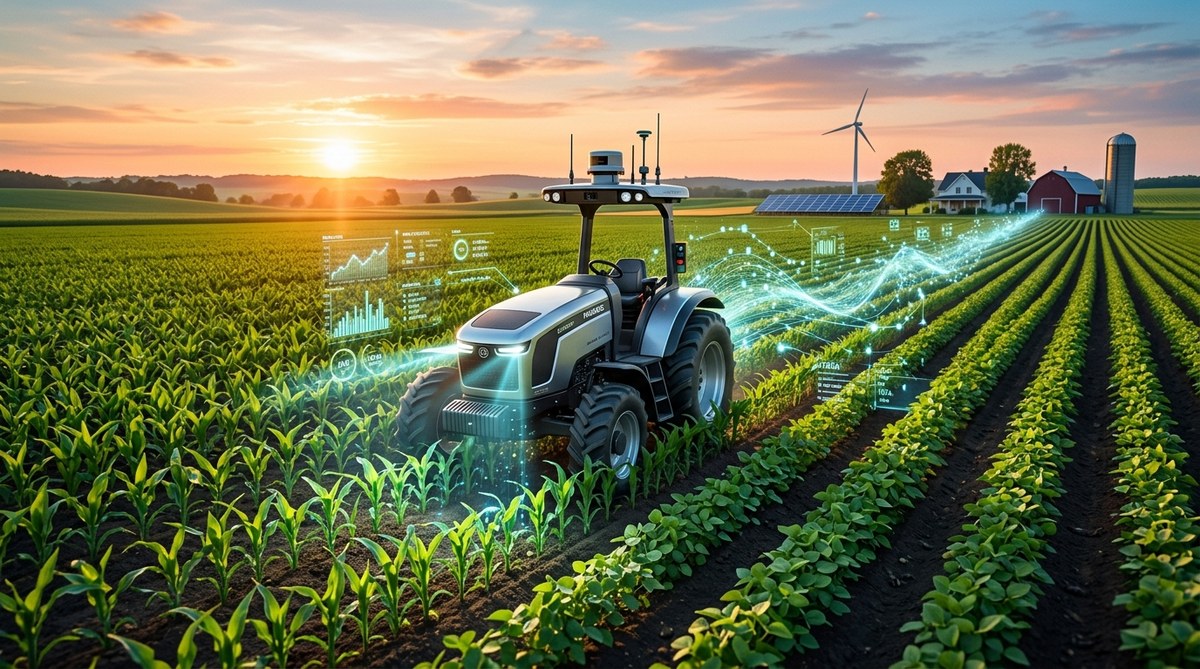
You are sitting in your truck at the edge of a 500 acre cornfield. It is 6:30 AM in late May, and the planter should have been rolling an hour ago. But your lead operator called in sick, and the backup is tied up on the other side of the county. So you wait. Every hour of daylight you lose costs you yield. This is the reality of modern farming: your operation is only as reliable as your labor force. But what if the tractor did not need an operator at all? What if it could work through the night, collect data on every seed it drops, and report back to you with a full field map before breakfast? That is the promise of the autonomous tractor. It is not a concept for some distant future. It is rolling into fields across the United States right now, and it is changing the economics of farming in 2026.
An autonomous tractor is more than a labor replacement. It is a data harvesting robot that collects precise field information every pass it makes. By combining GPS guidance, soil sensors, and real time analytics, these machines reduce input waste, cut labor dependency, and boost yields. For a forward thinking farm, the ROI often comes from the data itself, not just the hours saved.
What Makes a Tractor Autonomous?
You have likely seen GPS guided tractors with auto steer. That is not the same thing. An autonomous tractor operates without a human in the cab at all. It navigates using a combination of RTK GPS, LiDAR, and computer vision. It can start, stop, turn at headlands, and adjust its speed based on field conditions. Most models also carry a suite of sensors that monitor soil moisture, organic matter, and crop health as they move.
The machine learns the field boundaries from your initial mapping pass. After that, it can run the same route with centimeter level accuracy every single time. This consistency is where the real value starts to show up.
The Labor Problem Nobody Wants to Talk About
Let us be honest about the labor situation. Finding skilled equipment operators gets harder every season. The average age of the American farmer is nearly 60 years old. Younger workers often prefer jobs that do not require 14 hour days in a dusty cab. When you do find someone good, you pay a premium, and you hope they show up.
An autonomous tractor does not call in sick. It does not need breaks. It does not complain about working the night shift. One operator can supervise a fleet of three or four machines from a single tablet. That changes your labor math completely.
Here is a breakdown of how the labor costs shift:
| Traditional Tractor Operation | Autonomous Tractor Operation |
|---|---|
| One operator per machine | One supervisor per fleet |
| 10 to 12 hour shift max | 20+ hour operational window |
| Overtime and benefits costs | Software subscription and maintenance |
| High turnover and training | Minimal onboarding |
| Human error in overlapping passes | Consistent centimeter accuracy |
The savings are not just in wages. They are in the reduced stress of managing a crew, the elimination of overtime during tight planting windows, and the ability to run equipment when conditions are perfect, not when a driver is available.
How Data Harvesting Changes Your Bottom Line
The biggest shift in thinking is this: your tractor is now a sensor platform. Every time it crosses a field, it collects data. Soil compaction levels. Moisture variability. Emergence counts. Yield estimates.
Most farmers make decisions based on a handful of soil samples per acre and their gut feeling. An autonomous tractor running with the right sensors can generate thousands of data points per acre. That data feeds directly into variable rate application maps. You stop applying the same amount of seed, fertilizer, and chemical across an entire field. Instead, you treat each management zone according to its specific needs.
This is where the term “data harvesting” becomes literal. You are harvesting information that helps you grow more bushels per dollar spent. If you want to see how other growers are combining these data streams, check out our guide on harnessing farm data to boost crop productivity and efficiency.
Three Steps to Deploy Your First Autonomous Tractor
Making the switch does not have to be overwhelming. Here is a practical process that early adopters have used successfully.
-
Start with a single machine on your most critical field. Pick the field that gives you the highest return per acre. Plant it or harvest it with the autonomous unit first. This limits your risk and lets you learn the workflow without shutting down your entire operation.
-
Map your field boundaries and obstacles thoroughly. Walk the field with a handheld GPS or use a drone to create a high resolution orthomosaic. Mark every ditch, power pole, and irrigation riser. The machine needs this data to navigate safely.
-
Run a supervised trial for a full season. Stay within line of sight or use a remote camera feed. Monitor the machine’s decisions and override when needed. At the end of the season, compare the data from the autonomous passes against your conventional practice. The yield map will tell the story.
After one season, you will have enough confidence to scale. Many farmers find they want to run autonomous units on every field over 100 acres.
Common Mistakes When Adopting Autonomous Tractors
The technology is mature, but human habits take time to change. Here are the most common pitfalls and how to avoid them.
| Mistake | Why It Hurts | Better Approach |
|---|---|---|
| Skipping the soil sensor calibration | Bad data leads to bad variable rate maps | Calibrate sensors against lab samples at least twice per season |
| Assuming the machine can handle every condition | Heavy mud, tall weeds, or deep ruts can confuse sensors | Set weather and field condition limits in the software |
| Ignoring the data pipeline | Data is useless if you never look at it | Schedule a weekly review of field maps and adjust plans |
| Buying too many units at once | High upfront cost and steep learning curve | Lease one unit for a season before committing to a fleet |
| Forgetting about connectivity | Dead zones in the field can stop the machine | Install a cellular booster or use a mesh network across the farm |
If you are evaluating different models and want a checklist, our article on 7 questions to ask before choosing an autonomous tractor for your farm will help you compare options side by side.
What the Data Tells You That Your Eyes Cannot
A human operator can see a lot. But a human cannot see soil moisture at six inches depth across an entire field. A human cannot measure organic matter variability in real time. A human cannot track how many seeds went into each foot of row and compare that to the emergence rate three weeks later.
An autonomous tractor with the right sensor package can do all of that. It builds a digital record of every pass, every season. Over three to five years, that record becomes a powerful tool for predicting which hybrids perform best on which soil types, how irrigation timing affects test weight, and where drainage improvements will pay off.
“The first year you run an autonomous tractor, you are just learning. The second year you start seeing patterns. By the third year, you are making decisions based on data that your neighbors do not have access to. That is your competitive edge.” – Mark Sorensen, precision ag consultant in central Illinois
This kind of long term data is exactly what powers the strategies in our piece on top strategies for using data analytics to maximize crop yields.
The Efficiency Gains That Add Up
Let us look at the numbers from a real 2025 trial on a 2,000 acre corn and soybean operation in Iowa. The farm ran one autonomous tractor alongside two conventional units. Here is what they found:
- Fuel savings of 12% because the autonomous unit never overlapped passes and maintained optimal engine load.
- Seed savings of 8% through variable rate planting that matched population to soil potential.
- Labor hours reduced by 40% per acre because one supervisor ran all three machines.
- Yield increase of 5.3% on the fields managed with variable rate inputs driven by the autonomous tractor’s data.
These numbers are not outliers. They are becoming the baseline for farms that commit to the technology.
Integrating Autonomous Tractors with Your Existing Tech Stack
You do not need to rip out your current equipment to start. Most autonomous systems are designed to retrofit onto existing tractors. You remove the steering wheel and install the autonomy kit. The machine retains its original engine and hydraulics.
The software layer is where the magic happens. Your autonomous tractor should talk to your farm management system. It should send data to your cloud dashboard. It should integrate with your weather station and your soil sensor network. If you are building out this ecosystem, our guide on 7 steps to building a fully integrated smart farm system walks through the architecture.
Is 2026 the Right Year to Buy?
The technology has crossed a threshold. In 2023, autonomous kits were expensive and required constant babysitting. In 2026, the systems are more reliable, the software is more intuitive, and the price has come down as competition has increased. Several major equipment manufacturers now offer factory installed autonomy. The aftermarket retrofit market is also strong.
If you are on the fence, consider this: the labor shortage is not getting better. Input costs are not going down. The margin for error in farming is shrinking every year. An autonomous tractor gives you precision, consistency, and data that you cannot get any other way. It is an investment in your farm’s resilience.
For a deeper look at the financial side, read our analysis on is precision agriculture worth the investment in 2026.
Your Next Tractor Is a Robot That Learns
The machine you buy next will not just pull a planter or a grain cart. It will learn your fields. It will remember where the wet spots are in April and where the clay knobs dry out first in August. It will adjust its speed and depth automatically. It will hand you a report every morning showing exactly what happened overnight.
That is the shift. You are not buying a tractor. You are buying a data harvesting robot that happens to pull implements. The benefits for your farm go far beyond saving a few hours of labor. They go to the core of how you make decisions. Every pass adds to your knowledge base. Every season makes you smarter.
So when you sit in that truck at the edge of the field next spring, imagine watching your robot pull away from the shed at 5:30 AM, running perfectly on its line, collecting data with every foot it travels. You stay in the truck with your coffee and your tablet. You watch the yield map build in real time. That is the future of farming, and it is available right now.
Take the first step. Pick one field. Run one machine. See what the data tells you. You might be surprised by how much you have been missing.
