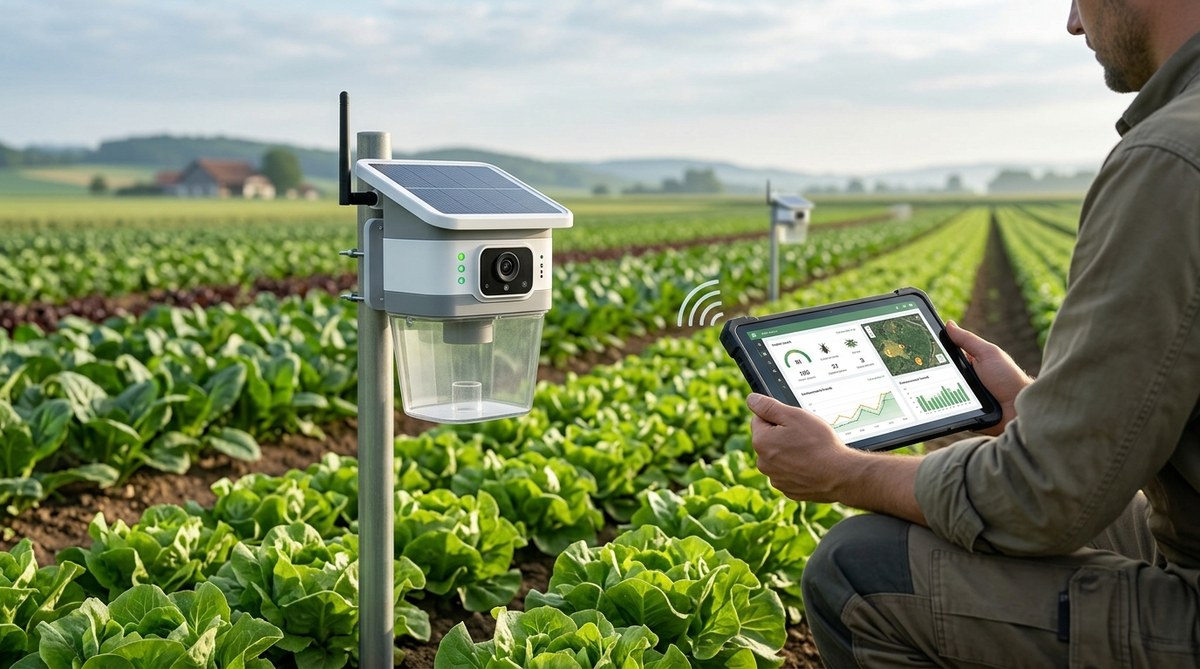
Sticky traps covered in dead bugs used to be the gold standard for pest monitoring. You would walk rows, count manually, and log numbers on a clipboard. That method still works, but it is slow, labor intensive, and it gives you a snapshot of the past. In 2026, the smartest farms are switching to a better approach. They use AI pest trap monitoring systems that combine IoT sensors, computer vision, and cloud analytics to deliver real-time insect data straight to a dashboard. This guide walks you through exactly how to set up those systems on your operation.
Integrating AI pest trap monitoring cuts scouting labor by up to 70 percent and catches infestations days earlier than manual checks. Start by selecting traps with onboard cameras and edge AI, then connect them to a mesh network or cellular gateway. Feed the data into a farm management platform that triggers spray alerts. Calibrate your system during the first season to reduce false positives and build a baseline for your specific pest pressure.
Why Traditional Scouting Falls Short in 2026
Walking fields with a sweep net or checking sticky cards once a week leaves huge gaps. A pest population can explode in 48 hours. By the time you spot the damage, the treatment window has narrowed. Manual scouting also suffers from human error. Two people counting the same trap might record different numbers. And those numbers sit in a notebook instead of feeding into a predictive model.
AI pest trap monitoring solves these problems. It gives you a continuous stream of data. You see the exact moment a pest species shows up, how fast the population grows, and where the hot spots are located. That level of detail changes how you spray, when you spray, and whether you spray at all.
What You Need to Get Started
Before you buy any hardware, understand the three core components of an AI pest trap system.
- Smart Traps with Embedded Cameras. These are not your grandfather’s pheromone lures. Modern traps have a sticky board or collection chamber, a high resolution camera, and a small computer that runs AI models on the edge. The camera snaps pictures at set intervals or when triggered by motion.
- Connectivity Layer. The trap needs to send image data to the cloud. Options include LoRaWAN, cellular (4G/5G), or Wi-Fi if the trap is near a building. LoRaWAN works well for large fields because it uses low power and covers long distances, but it sends small data packets. Cellular is better for high resolution image uploads.
- Analytics Dashboard. This is where the magic happens. The cloud platform receives the images, runs a second AI pass to identify species, and logs counts. You get charts, heat maps, and spray recommendations. Some platforms also integrate with variable rate sprayers for automatic treatment.
A Step by Step Integration Process
Follow these five steps to move from manual traps to a fully connected AI pest trap monitoring network.
-
Audit your fields and pest pressure. Map out your farm by crop type, field size, and historical pest issues. High risk areas like field edges near wood lines need denser trap placement. Low risk interior blocks can use fewer traps. A good rule of thumb is one smart trap per 10 to 20 acres, depending on crop value and pest mobility.
-
Select hardware that matches your connectivity. If your farm has reliable cellular coverage, choose traps with built in 4G modems. They send full resolution images and update every hour. If you farm in a rural area with spotty signal, use LoRaWAN traps that send compressed species counts rather than raw images. Pair them with a gateway that connects to the internet via satellite or long range cellular.
-
Install traps at the correct height and spacing. Most insect pests fly at specific heights above the crop canopy. For example, corn earworm moths fly higher than cutworms. Mount traps so the opening is at canopy level or slightly above. Space them evenly along field margins and interior rows. Avoid placing traps near dusty roads or irrigation heads that could clog the camera lens.
-
Configure the AI model for your region. Out of the box, most systems come with a general insect identification model. You need to train or fine tune that model for your local pest species. Upload images of the common pests in your area, like fall armyworm, stink bugs, or thrips. The AI learns to distinguish them from beneficial insects. This step dramatically reduces false positives.
-
Connect the dashboard to your spray decisions. The trap data is useless if it sits in a separate app. Integrate the monitoring platform with your farm management software or your sprayer controller. Set threshold alerts. For instance, if the trap catches more than five corn earworm moths in a night, the system sends a text and flags that field for treatment.
Common Mistakes and How to Avoid Them
Even experienced farmers make errors when deploying AI pest trap monitoring. The table below shows the most frequent mistakes and the fixes that keep your system accurate.
| Mistake | Why It Hurts | The Fix |
|---|---|---|
| Placing traps too close together | Overlapping detection zones waste hardware and skew population density maps | Keep at least 200 feet between traps in open fields |
| Ignoring weather data | Rain and fog can blur camera images and reduce trap catch rates | Use traps with heated lenses or schedule image captures during dry windows |
| Using the same AI model all season | Pest species change as crops mature; a model trained on seedling pests misses pod feeders | Retrain the model monthly with new images from your fields |
| Forgetting to clean sticky boards | A full board hides new captures and the AI cannot count accurately | Set a cleaning schedule based on pest pressure; every 7 to 14 days is typical |
| Skipping baseline data collection | Without a season of historical data, the AI cannot distinguish normal fluctuations from outbreaks | Run the system for one full season before relying on it for automated spray decisions |
How to Read the Data Like a Pro
The dashboard will show you counts, species breakdowns, and heat maps. Do not just look at the total number. Pay attention to trends.
A sudden spike in a single species often means a new generation has emerged. That is your treatment trigger. A steady low count over several days might indicate that beneficial insects are keeping things in check. Hold off on spraying and let the predators work.
Use the heat map to find the leading edge of an infestation. If the traps on the west side of a field show high counts while the east side is clean, you can spot spray only the west side. That saves money and spares beneficials.
“The biggest advantage of AI pest trap monitoring is not the fancy hardware. It is the ability to stop spraying entire fields when only 10 percent of the area has a problem. That is where the real ROI lives.” – Dr. Maria Santos, precision agriculture consultant
Integrating AI Pest Trap Monitoring with Your Other Farm Tech
Your trap system should not live in a silo. Connect it to your other digital tools for maximum impact. For example, combine trap data with satellite imagery to confirm that stressed areas in the field map match high pest counts. That cross reference gives you confidence before you load the sprayer.
You can also feed trap data into a predictive analytics model that forecasts pest pressure for the next week. If the model predicts a surge, you can schedule a drone flight to scout the hot spot or preload your sprayer with the right chemistry. This kind of integration turns reactive pest control into proactive management.
For a deeper look at how data flows through a modern farm, check out our guide on harnessing IoT devices to transform modern farming practices. It covers the connectivity backbone that makes real time monitoring possible.
What the 2026 Season Looks Like with AI Traps
Imagine a typical July morning. You open your phone and see a notification: “Field 4, West Block: 12 corn earworm moths captured overnight. Threshold exceeded.” The dashboard shows a heat map with a red patch along the tree line. You tap the field and the system suggests a treatment based on the specific pest stage. You approve the spray order, and it sends directly to your variable rate sprayer. The whole process takes three minutes.
Compare that to the old way. You would have driven to the field, walked to each sticky trap, counted by hand, driven back, and entered numbers into a spreadsheet. By the time you made a decision, the moths could have laid eggs across the entire field.
A Practical Checklist for Your First Deployment
Before you commit to a full rollout, run a pilot on one or two fields. Use this checklist to stay on track.
- Choose a field with a known pest history so you can compare AI results against manual counts
- Install traps at least two weeks before the typical pest arrival date
- Set the image capture interval to every 30 minutes during peak flight hours (dusk to dawn)
- Download the dashboard app and configure push alerts for your top three pest species
- Walk the field once a week for the first month to validate the AI identifications
- Adjust the species model if you see mismatches, like the AI calling a ladybug a pest
After the pilot season, review the data. How many false positives did the system generate? Did you catch an infestation earlier than usual? Use those answers to scale up across your whole farm.
Building a Long Term Pest Management Strategy
AI pest trap monitoring gives you a massive dataset over time. After two or three seasons, you will see patterns. Certain pests always arrive after a specific degree day accumulation. Some fields consistently have higher pressure than others. You can use that historical data to plan preventive treatments, adjust planting dates, or choose resistant varieties.
This is where the technology really pays off. It shifts your pest management from reactive to strategic. You stop fighting fires and start preventing them.
For more ideas on using data to make smarter decisions, read our article on top strategies for using data analytics to maximize crop yields. It pairs well with your trap monitoring efforts.
Making the Switch This Season
You do not need to replace every trap overnight. Start with a small deployment. Learn the system. Let the AI learn your fields. The first season will have a learning curve, but the payoff comes fast. You will save scouting hours, reduce unnecessary sprays, and sleep better knowing you have eyes on your fields 24/7.
AI pest trap monitoring is not a futuristic concept. It is a practical tool that works today. The hardware is reliable, the software is getting smarter every month, and the cost per acre keeps dropping. If you are serious about precision agriculture in 2026, this is one of the easiest wins you can make.
Set up those smart traps. Connect the dashboard. Let the data guide your next spray decision. Your fields, your wallet, and your local beneficial insects will thank you.
