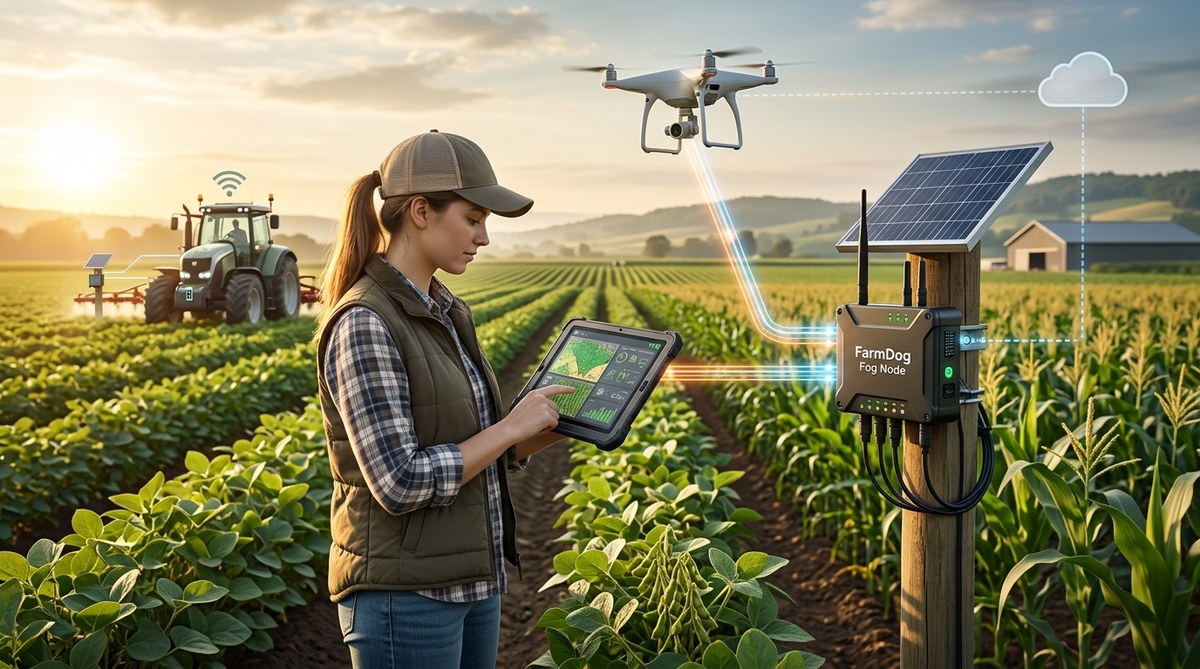
You are standing in a soybean field in central Illinois. A drone overhead just spotted a patch of sudden wilt spreading near the center pivot. The soil moisture sensors in that zone are screaming dry, but the weather API says rain is 15 minutes out. Do you irrigate now or wait?
If your system needs to send that data to a cloud server 800 miles away, process it, and send a command back, the wilt could double in size before you get an answer. That lag is not acceptable for time sensitive field operations. Fog computing fixes this by moving the processing power closer to where the data is generated, right to the edge of your farm network.
Fog computing layers processing nodes between your field sensors and the central cloud, cutting decision latency from seconds to milliseconds. For IT architects building real time ag systems, this means your autonomous tractors, irrigation controllers, and drone fleets can react instantly without waiting for a round trip to a distant data center. The result is faster, more precise field actions.
Why Cloud Only Falls Short in the Field
Cloud computing is powerful. It handles massive storage and complex analytics. But it has a physical limitation. Light and electricity can only travel so fast. A round trip from a sensor in rural Nebraska to a cloud data center in Oregon can take 300 to 800 milliseconds. That might sound acceptable for a web page load, but for a variable rate irrigation valve that needs to close before a rain cell hits, 800 milliseconds is an eternity.
Real time field decisions demand sub 100 millisecond response times. Fog computing delivers that by placing intermediate nodes, called fog nodes, on or near the farm. These nodes handle time critical processing locally and only send summarized data to the cloud for long term storage and analysis.
The Fog Layer Explained
Think of fog computing as a middle layer between your IoT sensors and the cloud. It is not a replacement for either. It is a performance booster.
- Sensors and actuators live at the edge. They collect soil moisture, temperature, pest counts, and crop health data.
- Fog nodes sit on the farm network. They can be a ruggedized mini PC in the equipment shed, a gateway on a tractor, or a small server in the field office.
- Cloud servers handle non urgent tasks like training machine learning models, generating end of season reports, and storing historical data.
When a soil sensor detects a drop in moisture, the fog node processes that reading locally. It checks the current weather forecast, evaluates the crop stage, and decides whether to trigger irrigation. All of this happens in under 50 milliseconds. The fog node then sends a simple log entry to the cloud for record keeping.
How to Implement Fog Computing for Real Time Field Decisions
Here is a practical process to design a fog computing layer for your farm operations. This assumes you already have IoT sensors and some cloud infrastructure in place.
-
Map your latency critical decisions. List every field operation that cannot tolerate a delay. Examples include closing irrigation valves before a storm, adjusting sprayer nozzle flow in variable rate applications, and steering autonomous harvesters around obstacles. Prioritize these.
-
Select your fog node hardware. You do not need a data center in a barn. Small, low power computers like a Raspberry Pi 5 or an Intel NUC work well for most farms. For larger operations with dozens of sensors, consider a ruggedized edge server rated for outdoor temperatures. Ensure the node has enough processing power to run your inference models locally.
-
Deploy local processing software. Install a lightweight runtime for your decision logic. Node RED, a Python Flask app, or a dedicated edge computing platform like Balena or AWS IoT Greengrass can run on your fog node. Write simple if then rules or load a small machine learning model for tasks like pest detection.
-
Connect sensors directly to the fog node. Use local networks like LoRaWAN, Zigbee, or Wi-Fi to send sensor data to the fog node without going through the internet. This keeps the data path short and fast.
-
Set up a fallback to the cloud. The fog node should store data locally and sync to the cloud when connectivity is available. If the node fails, the sensors should still be able to reach the cloud directly as a backup.
Common Mistakes and How to Avoid Them
| Mistake | Why It Hurts Latency | Better Approach |
|---|---|---|
| Using the fog node as a simple data relay | Adds no processing value; still depends on cloud round trip | Run decision logic on the fog node itself |
| Overloading the fog node with too many sensors | Causes processing delays and memory errors | Limit each fog node to 50 to 100 sensors depending on hardware |
| Skipping local storage | Loses data when the internet goes down | Equip the fog node with an SSD or SD card for buffering |
| Ignoring security on the fog node | Creates a vulnerable entry point to the farm network | Use encrypted communication and regular firmware updates |
| Treating all data as high priority | Wastes processing power on non urgent readings | Classify data into real time, near real time, and batch |
When Milliseconds Decide the Next Season
“In precision agriculture, the difference between a good decision and a great one is often less than a second. If your system cannot act within that window, you are not farming in real time. You are farming in hindsight.” — Dr. Elena Marquez, ag tech systems architect
Consider a variable rate nitrogen application. The sprayer is moving at 12 miles per hour. The soil sensor array sends a reading every 10 feet. If the system takes 500 milliseconds to process the reading and adjust the nozzle, the sprayer has already traveled more than 8 feet past the target zone. That wasted nitrogen costs money and hurts yield.
With fog computing, the nozzle adjustment happens in under 30 milliseconds. The sprayer covers less than 6 inches before the correction. That is the difference between precision and waste.
Building a Fog Node That Keeps Up With Harvest
A well configured fog node does more than just relay data. It should handle these tasks locally:
- Filter out noisy sensor readings before they eat up bandwidth
- Run basic anomaly detection to flag sensors that may be failing
- Execute time critical control commands for irrigation, spraying, and harvesting
- Cache data during internet outages and sync when the connection returns
- Provide a local dashboard for the operator in the field
This approach reduces the load on your cloud infrastructure and makes your farm network resilient to connectivity issues. Many rural areas still struggle with reliable internet. Fog computing ensures your field operations keep running even when the cloud is unreachable.
A Real World Example: Fog Controlled Irrigation
Let us walk through a typical scenario. A corn field in eastern Iowa has 20 soil moisture sensors spread across 160 acres. Each sensor reports every 5 minutes. The weather API shows a 70 percent chance of rain in the next 20 minutes.
Cloud only approach: Sensors send data to a server in Chicago. The server processes the data, checks the weather API, and sends a command back to close the irrigation valves. Total round trip time is 600 milliseconds. The valves close, but the system was slow enough that a few zones got overwatered.
Fog approach: Sensors send data to a fog node in the field shed. The fog node runs a local script that checks moisture levels and the cached weather forecast. It closes the valves in 40 milliseconds. No water is wasted. The fog node then sends a brief log to the cloud: “Valves closed at 14:32:05 due to forecasted rain.”
Integrating Fog Computing With Your Existing Systems
You do not need to rip out your current setup. Fog computing layers on top of what you already have. If you are already using edge computing for smart farming decisions, the fog layer extends that capability by adding a distributed network of processing nodes across your farm.
For IT architects, the key is to design the fog layer as an abstraction. Your field applications should not care whether they are talking to a fog node or the cloud. They should just send data and receive commands. The fog node handles the routing and processing transparently.
What Your Fog Node Needs to Run
| Component | Minimum Spec | Recommended Spec |
|---|---|---|
| CPU | Quad core 1.5 GHz | Hexa core 2.5 GHz |
| RAM | 4 GB | 8 GB |
| Storage | 32 GB SSD | 128 GB SSD |
| Network | Wi-Fi 5, Ethernet | Wi-Fi 6, 5G, Ethernet |
| Power | 15 W USB C | 25 W PoE or solar |
| OS | Linux (Raspbian, Ubuntu) | Linux (Ubuntu Server) |
The recommended specs handle up to 100 sensors with local inference models. If you are managing a larger farm, you can deploy multiple fog nodes and let them communicate over a local mesh network.
The Role of Fog in Autonomous Field Operations
Autonomous tractors and harvesters generate enormous amounts of data every second. Sending all of that to the cloud for processing is impractical. Fog computing allows the vehicle to process sensor data locally and make driving and operational decisions in real time.
For example, an autonomous sprayer needs to detect weeds, identify the crop row, and adjust its speed and nozzle angle. If it relies on the cloud, a momentary connectivity drop could cause it to veer off course. With a fog node onboard, the sprayer has full autonomy even in areas with poor cellular coverage.
You can learn more about integrating these systems in our guide on building a fully integrated smart farm system.
Putting Fog Computing to Work This Season
Fog computing is not theoretical. It is available today and it works. The hardware is affordable, the software is mature, and the benefits are measurable. For IT architects and systems engineers evaluating technologies to reduce decision latency, fog computing is the most practical path forward.
Start small. Pick one time sensitive decision on your farm, perhaps irrigation control or variable rate spraying. Deploy a single fog node and measure the latency improvement. Once you see the results, expand to other operations. Before long, your entire farm network will be making real time decisions without waiting on the cloud.
The fields are not getting any smaller and the seasons are not getting any longer. Reducing latency with fog computing means you can make more decisions per minute, per hour, and per season. That adds up to healthier crops, lower input costs, and a farm that runs itself a little better every day.
