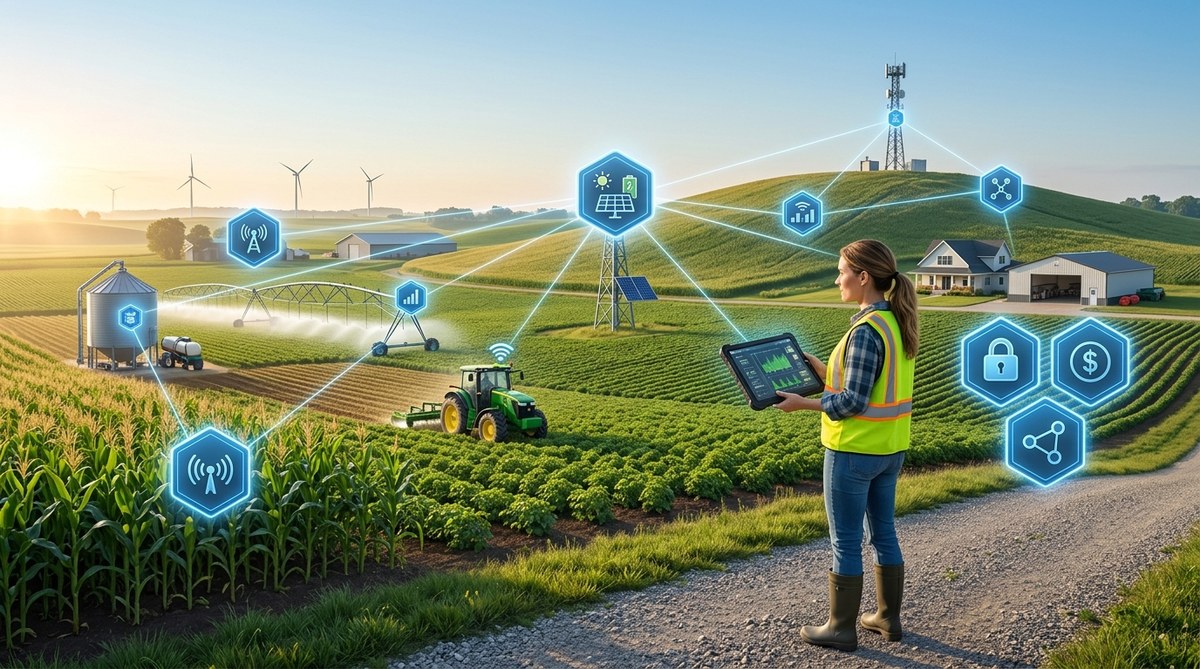
You are standing in a soybean field in late July. The temperature is pushing 95 degrees, and your irrigation pivot is running. A sensor in the corner of the field stops reporting. You drive out there, find a dead battery, swap it, and drive back. That trip cost you an hour and a half of labor. A farm-wide 5G mesh network could have alerted you to the battery drop in real time, saving that trip. But before you call a contractor, you need to know what you are getting into.
Installing a farm-wide 5G mesh network is not just about speed. It is about coverage, device compatibility, power requirements, and long-term cost. Asking the right questions before you sign a contract can prevent dead zones, interoperability headaches, and budget overruns. This guide covers the seven most critical questions every farm operator should ask.
Start with your actual coverage needs
A mesh network sounds simple. You place nodes around the property, and they talk to each other. But farms are not suburban homes. You have metal grain bins, rolling hills, dense tree lines, and long distances between buildings. A 5G signal struggles with physical obstructions more than older 4G or LoRaWAN signals.
Ask your installer for a site survey that includes a heat map of signal strength across every acre you plan to cover. Do not rely on theoretical range numbers from a datasheet. A good installer will walk the property with a spectrum analyzer and show you where signals drop.
If you are looking at a 500-acre corn operation with a single barn and a few remote pump houses, your mesh might need as few as three nodes. A 2,000-acre cattle ranch with multiple sheds, feeding lots, and pasture gates could need a dozen or more. Get a written estimate of node count before you agree to anything.
What devices will actually connect
Not every smart farming tool uses the same radio frequency or protocol. Some soil sensors run on LoRaWAN. Drones often use Wi-Fi 6 or 5G. Irrigation controllers may rely on cellular LTE. A 5G mesh network can handle many of these, but only if the access points support backward compatibility.
Make a list of every connected device you own or plan to buy in the next two years. Include:
- Soil moisture sensors
- Weather stations
- Drone bases
- GPS guidance systems for tractors
- Livestock ear tags and collars
- Security cameras
- Automated gate controllers
Check the technical specs for each device. If any of them use 2.4 GHz Wi-Fi only, your 5G mesh must include dual-band or tri-band radios. If they rely on LTE Cat-M, your mesh needs a cellular gateway. Otherwise, you end up running two separate networks, which defeats the purpose of a single farm-wide system.
For more on the devices themselves, read our guide on harnessing IoT devices to transform modern farming practices. It covers the sensors and controllers that will benefit most from a robust network.
Power and placement matter more than you think
A 5G mesh node needs electricity. Some nodes can run on Power over Ethernet (PoE), which means you need a Cat6 cable running to each one. Other nodes are outdoor-rated and can use solar panels with battery backups. But solar adds cost and requires enough sunlight hours for your region.
Create a power plan for each node location. For a node mounted on a grain bin, you can run PoE from the bin’s existing electrical panel. For a node in the middle of a pasture, you need a solar panel, a battery, and a charge controller. That setup can add $400 to $600 per node.
Also consider winter conditions. Snow covering a solar panel kills the charge. Ice on a node antenna reduces range. Ask the installer about cold-weather ratings and snow-shedding designs.
Data backhaul and internet connection
Your farm-wide mesh is only as useful as the internet connection it connects to. If you have a single DSL line running to the farmhouse, that becomes a bottleneck for all 5G traffic. You need a backhaul connection that can handle the aggregate data from every sensor, camera, and drone on the property.
Ask your installer about backhaul options:
- Fiber optic to the farm (best, but expensive)
- Fixed wireless from a local ISP (good, but variable latency)
- Starlink or other low-earth-orbit satellite (improving, but can have brief dropouts)
- Cellular bonding (multiple LTE/5G modems combined)
A good rule of thumb is to have at least 50 Mbps of symmetrical backhaul for every 50 devices that stream video or send frequent data. If you plan to run 20 security cameras, bump that number up.
Will the network grow with you
Farming changes. You may add a new irrigation block next year, install a robotic milking parlor, or start using autonomous tractors. Your mesh network should not be a one-time installation that becomes obsolete.
Ask the installer about node density limits. Some mesh systems cap out at 32 nodes. Others can handle hundreds. If you are planning for the long term, choose a system that supports at least 64 nodes and can be upgraded to Wi-Fi 7 or future 5G standards without replacing all the hardware.
Also ask about software updates. A network that cannot receive firmware updates is a security risk. You want a system that the manufacturer supports for at least five years.
Cost breakdown beyond the hardware
The price tag for a farm 5G mesh network is not just the nodes. You also pay for:
- Site survey and design fees
- Cabling and trenching (if you bury Ethernet)
- Mounting hardware and poles
- Solar panels and batteries (if needed)
- Installation labor
- Software licensing and cloud management fees
- Ongoing support and maintenance contracts
Get a line-item quote. Some installers bundle everything into one number, which makes comparison shopping hard. Ask for the hardware cost separately from labor and software.
Here is a rough comparison table for a typical 1,000-acre grain farm:
| Item | Low-end estimate | Mid-range estimate | High-end estimate |
|---|---|---|---|
| Site survey | $500 | $1,200 | $2,500 |
| 5G mesh nodes (6 units) | $3,000 | $6,000 | $12,000 |
| PoE cabling and trenching | $1,500 | $3,000 | $6,000 |
| Solar power kits (2 nodes) | $800 | $1,600 | $2,400 |
| Installation labor | $2,000 | $4,000 | $8,000 |
| Software license (annual) | $600 | $1,200 | $2,400 |
| Total first year | $8,400 | $17,000 | $33,300 |
These numbers are ballpark for 2026. Your actual cost depends on terrain, distance from power, and node count.
What happens when something breaks
Farms operate 24/7 during planting and harvest. A network outage in April can delay soil sensor readings that inform your fertilizer plan. An outage in October can cut off yield monitor data from combines.
Ask about service level agreements (SLAs). A good SLA guarantees a response time of four hours or less during critical seasons. Some providers offer spare node replacement within 24 hours. Others expect you to troubleshoot over the phone.
Also ask about remote diagnostics. Can the installer log into the network management dashboard and see which node is offline without driving to it? That feature alone can save hours of troubleshooting time.
“The best network installer is the one who treats your farm like their own. They should know that a dead node in a remote pasture is not just an inconvenience. It is a lost data point that affects your bottom line.” — Mark Tillman, ag technology consultant
Putting it all together
Before you sign any contract, write down your answers to these seven questions:
- What is the actual coverage area and signal strength across my fields?
- Which devices will connect, and are they compatible with the network?
- How will each node get power, and what happens in winter?
- What backhaul internet connection will support the network?
- Can the network scale to 64+ nodes and future standards?
- What is the total cost broken down by hardware, labor, and software?
- What is the guaranteed support response time during planting and harvest?
Take those answers and compare them across at least two different installers. If one installer dodges the questions, move on. A transparent provider is worth the premium.
Your farm is not a suburban home. It is a production facility that runs on data in 2026. A 5G mesh network can be the backbone that connects your soil sensors, drones, and irrigation systems into one cohesive system. But only if you ask the right questions before installation.
Start with the coverage map. Confirm device compatibility. Plan for power and backhaul. And always, always get the support terms in writing. That is how you turn a technology investment into a real productivity gain.
For more on making data work for your operation, check out our guide on top strategies for using data analytics to maximize crop yields. It pairs naturally with a solid network foundation.
Your next step on the farm network journey
You do not need to become a networking expert. But you do need to be an informed buyer. The seven questions above give you a framework to evaluate any proposal. Use them. Write down the answers. Compare them. Then make your decision with confidence.
A farm-wide 5G mesh network is a big investment. It is also one of the most impactful upgrades you can make for precision agriculture in 2026. When the network works, your data flows, your alerts come on time, and you spend less time driving to check on things. That is the goal.
Take this article with you to your next meeting with an installer. Ask every question on the list. If they hesitate on any of them, that is a red flag. If they answer clearly and back it up with a site survey, you have found a partner worth working with.
Here is to better connectivity and smarter farming.
