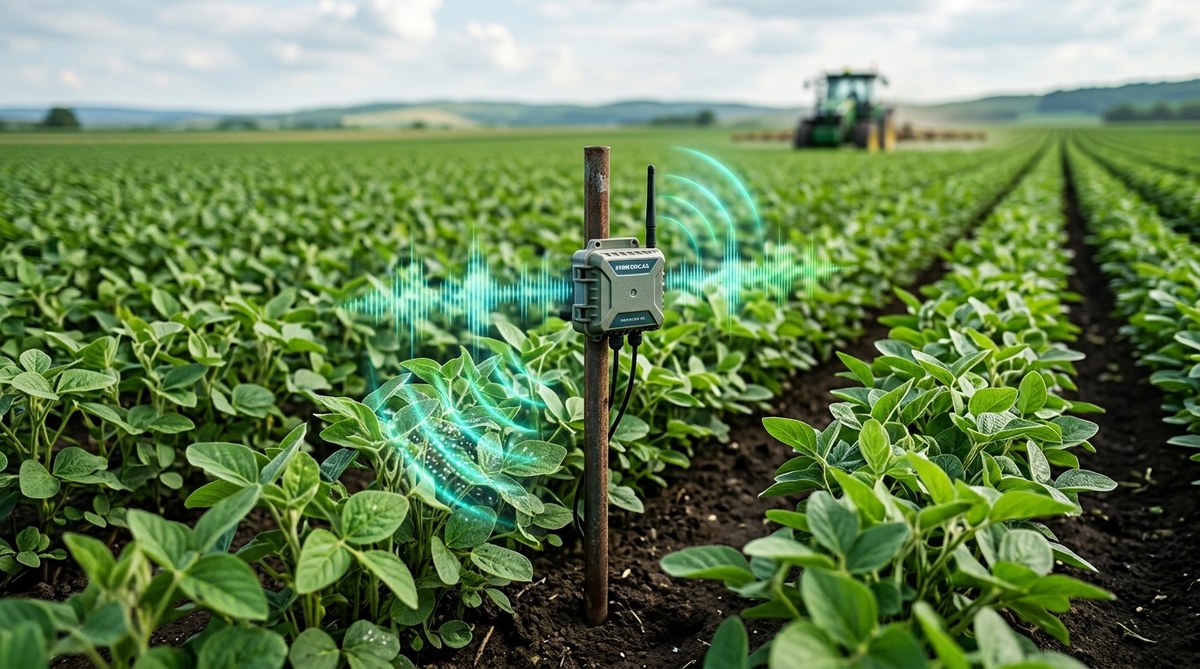
Plants can’t tell you they are thirsty or infected. But they can show it, long before any visual signs appear. The key is listening at a frequency humans cannot hear. Bio-acoustic sensors for crop stress detection are changing how we monitor field health. These devices pick up ultrasonic emissions from plants under duress, giving growers a head start on intervention. For precision agriculture researchers and agronomists, this technology offers a non-invasive way to see stress before leaves wilt or discolor. It is a shift from reactive scouting to proactive management.
Bio-acoustic sensors detect ultrasonic clicks and pops emitted by plants under stress from drought, disease, or nutrient deficiency. These signals appear days before visual symptoms. By integrating these sensors with IoT platforms, growers can pinpoint trouble spots, reduce water waste, and apply treatments only where needed. This guide covers how the technology works, how to deploy it, and how to interpret the data for smarter field decisions.
How Plants Leak Their Secrets Through Sound
Plants are not silent. When water molecules break apart in drying soil, or when air bubbles form in the xylem under drought stress, they create tiny implosions. These events produce ultrasonic clicks in the 20 to 300 kHz range. Bio-acoustic sensors for crop stress detection capture these sounds using sensitive microphones or piezoelectric contact sensors attached to stems or leaves.
Researchers at several land-grant universities have shown that these acoustic emissions correlate strongly with water potential. In one 2025 study from the University of Nebraska, corn plants under mild water stress emitted 40% more ultrasonic clicks than well-watered controls, a full 48 hours before leaf rolling was visible. The same principle applies to other stressors. Fungal hyphae growing through cell walls produce a distinct crackling pattern. Root-feeding nematodes create low-frequency vibrations as they move through tissue.
The technology is not new in forestry. Foresters have used acoustic detection to find wood-boring beetles for years. What is new is the miniaturization of sensors and the processing power to filter out wind and machinery noise. Now these tools are practical for row crops, orchards, and vineyards.
A Step-by-Step Process for Field Deployment
Setting up a bio-acoustic monitoring system does not require a PhD in signal processing. Most modern kits come with pre-configured algorithms. Here is a practical process to get started.
-
Select sensor locations. Place sensors on representative plants across the field. Avoid edges and areas with known soil compaction. For a 40-acre cornfield, five to seven sensor stations provide good coverage. Attach the sensor to the main stem about six inches above the soil line using a soft silicone band. Do not clamp too tight. The plant needs room to expand.
-
Configure the recording window. Set the system to record for 15 minutes every hour during peak transpiration hours (10 a.m. to 4 p.m.). This captures the most stress signals. Night recordings pick up less plant activity and more insect noise.
-
Apply a noise filter. Wind, irrigation pumps, and passing tractors create false positives. Use a high-pass filter set at 20 kHz to block low-frequency background rumble. Most commercial sensors include this filter by default.
-
Set a baseline. Run the system for three days under normal irrigation or rainfall. This gives you a baseline emission rate for that crop at that growth stage. A sudden spike above two standard deviations from the baseline triggers an alert.
-
Correlate with ground truth. Walk the flagged zones and check soil moisture with a probe or look for early signs like slight leaf angle changes. This validation step builds confidence in the sensor data.
-
Integrate with your farm management software. Many platforms can push acoustic alerts directly to a dashboard. This allows you to overlay stress maps with NDVI imagery or soil sensor data for a complete picture.
What to Scan For in Acoustic Data
Not all clicks are the same. Different stressors produce distinct acoustic signatures. Here is a quick reference for what to look for.
- Drought stress. High frequency clicks (50-150 kHz) in irregular bursts. Often occurs in mid-afternoon when transpiration peaks.
- Disease infection. Lower frequency crackling (20-80 kHz) with a rhythmic pattern. Can be detected 24 to 72 hours before lesions appear.
- Nutrient deficiency. Subtle, continuous hissing in the 100-200 kHz range. Often masked by other sounds, so requires clean recordings.
- Root pest activity. Irregular low-frequency pops (10-30 kHz) especially at night when pests are most active.
Comparing Detection Methods
Bio-acoustic sensors are one tool among many. The table below shows how they stack up against other early stress detection methods.
| Method | Detection Speed | Cost per Acre | Skill Required | False Positive Rate |
|---|---|---|---|---|
| Visual scouting | 48-72 hours after onset | Low | Moderate | High (late detection) |
| NDVI drone mapping | 24-48 hours | Medium | High | Moderate |
| Soil moisture sensors | Real-time | Medium | Low | Low (only measures water) |
| Bio-acoustic sensors | 12-24 hours | Medium | Moderate | Low (with proper filtering) |
| Sap flow meters | Real-time | High | High | Low |
Bio-acoustic sensors offer the best balance of early detection and moderate cost for most field crops. They do not replace other tools but complement them. For example, pairing acoustic sensors with soil moisture data gives you both the cause (low water) and the effect (plant stress response).
Common Mistakes and How to Avoid Them
Adopting any new sensor technology comes with a learning curve. Here are the most frequent errors agronomists make when deploying bio-acoustic systems.
- Placing sensors on stressed plants. If you put a sensor on a plant that is already wilting, you miss the whole point. Install sensors on healthy plants and let them report the first signs of trouble.
- Ignoring temperature effects. Acoustic emissions increase with temperature even in well-watered plants. Always compare readings at the same time of day and normalize for temperature using a built-in thermometer.
- Overlooking insect noise. Crickets and leafhoppers produce sounds in the same frequency range as some stress signals. Use a reference sensor placed in a non-crop area to subtract background insect chatter.
- Skipping the baseline period. Without a baseline, you have no way to know what normal looks like for that field. Run the system for at least 72 hours during good conditions before making decisions.
“The biggest mistake I see is people treating acoustic data like a thermometer. It is not a single number. It is a pattern. You need to learn the rhythm of your field before you can spot the anomaly.” – Dr. Maria Santos, precision ag researcher at UC Davis
Building a Complete Monitoring System
Bio-acoustic sensors work best when integrated into a broader data ecosystem. Consider combining them with these complementary tools.
- IoT soil sensors. Measure moisture and temperature at root level. Cross-reference acoustic spikes with drying soil to confirm drought stress. Learn more about implementing digital soil sensors for better crop management outcomes.
- Weather stations. Wind speed and humidity affect acoustic transmission. Knowing the weather context prevents false alarms on windy days. See how smart sensors are revolutionizing irrigation efficiency in 2026.
- Drone imagery. Use multispectral drone flights to validate acoustic alerts at scale. A flagged acoustic zone that also shows a dip in NDVI confirms the problem. Check out how to use multispectral drone mapping to detect nutrient deficiencies in corn.
- Machine learning models. Train a model on your historical acoustic data to predict which stress events are likely to escalate. This is where predictive analytics is a game changer for crop management in 2026.
Making Sense of the Data Stream
Raw acoustic data is noisy. A good sensor system will process the signal on the edge (right in the field) and only send alerts to your phone. But you still need to interpret what the alerts mean.
Create a simple decision matrix. If the sensor shows a moderate spike (two to three times baseline) and soil moisture is adequate, suspect disease or pest pressure. If the spike coincides with dropping soil moisture, the cause is likely water stress. If both conditions are normal, check the sensor for physical damage or debris.
Log every alert and the action you took. Over a season, you will build a library of acoustic signatures specific to your farm. That library becomes more valuable each year.
The Future of Listening to Crops
Bio-acoustic technology is advancing fast. In 2026, several startups are testing solar-powered sensors that can run all season without battery changes. Researchers are also working on species-specific algorithms that can distinguish between corn, soybean, and wheat stress signals automatically.
The next frontier is combining acoustic data with computer vision. Imagine a system that hears a stress click, then directs a camera to zoom in on that specific plant for a visual check. That level of integration is already in prototype trials in the Central Valley of California.
For now, the most practical application is early drought detection. With water costs rising across the United States, knowing exactly when and where to irrigate can save thousands of dollars per season. Bio-acoustic sensors give you that information two days earlier than walking the field.
Getting Started Without Overcommitting
You do not need to wire your entire farm at once. Start with one field that has a history of variable performance. Install three to five sensor nodes and run them for two weeks. Compare the acoustic data with your standard scouting reports. Once you see the pattern, you will trust the technology.
Most sensor manufacturers offer rental kits for a single season. This is a low-risk way to test the system before buying. Look for kits that include a simple dashboard and phone alerts. Avoid systems that require you to download raw audio files and analyze them yourself. That is a time sink.
If you are already using IoT devices to transform modern farming practices, adding acoustic sensors is a natural next step. They fill the gap between soil sensors (which measure the environment) and visual observations (which measure the result). Acoustic sensors measure the plant’s real-time response.
Listening Is the New Looking
For decades, agronomists have relied on their eyes to judge crop health. Bio-acoustic sensors for crop stress detection add a new sense to the toolkit. They let you hear what the plant is feeling before it shows any outward signs. That extra 24 to 48 hours of warning can be the difference between a minor stress event and a yield loss.
Start small, validate the data, and let the technology prove itself in your fields. Your crops have been talking all along. It is time to start listening.
