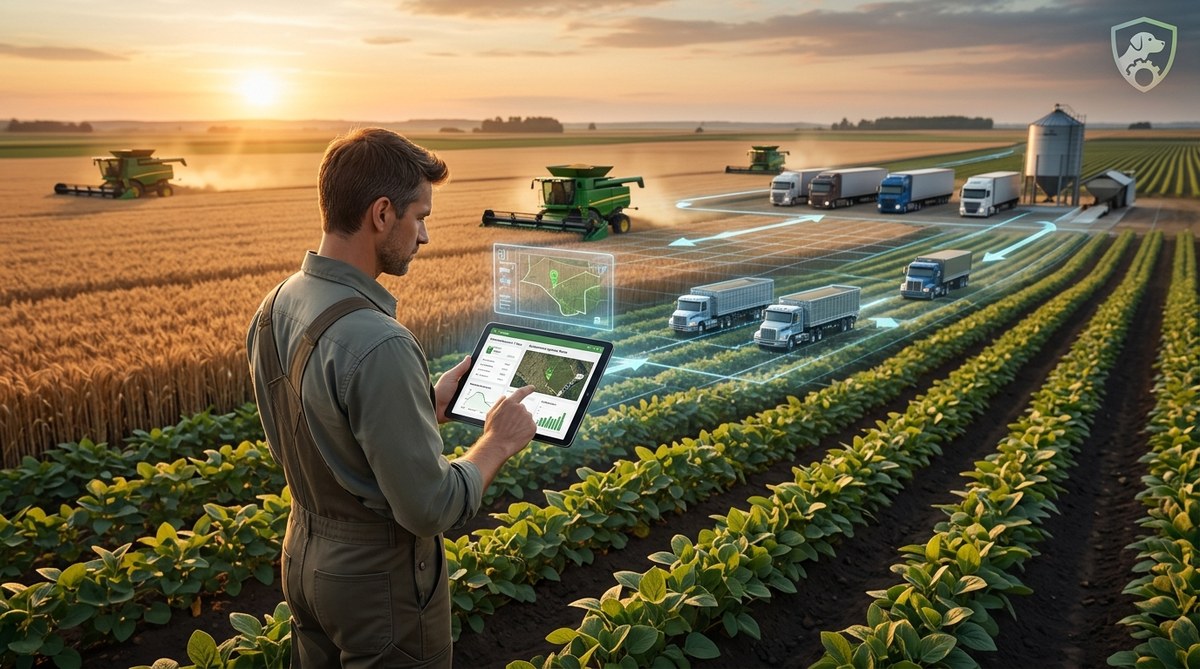
You walk through a field of soybeans in late summer, pull a pod, and rub it between your palms. The seeds feel full, but are they ready? You check your notes from last week, glance at the sky, and make a call. That call determines when the combines roll, when the trucks show up, and whether the grain makes it to the elevator before the price drops. For decades, that decision has relied on gut feel and experience. Both are valuable. But in 2026, they are not enough.
AI harvest prediction logistics changes that equation. It combines field sensors, weather data, satellite imagery, and machine learning models to tell you not just when to harvest, but how to move every piece of the supply chain into position. No more guesswork. No more last-minute calls to the trucking company. Just a data-backed window that protects your yield and your profit.
AI harvest prediction logistics uses real-time data and machine learning to forecast the optimal harvest window with 90% or greater accuracy. By integrating weather models, soil moisture sensors, and crop maturity algorithms, farm managers can schedule labor, equipment, and transport with confidence. This approach reduces spoilage, cuts freight costs, and boosts net revenue per acre.
How AI Predicts the Harvest Window
The core of AI harvest prediction logistics is a model that learns from your fields. It ingests data from multiple sources and finds patterns a human eye would miss. Here is what the model typically looks at:
- Weather history and forecasts — temperature, rainfall, humidity, and frost dates.
- Crop development data — growing degree days (GDD), canopy cover, and kernel moisture.
- Soil conditions — moisture levels at different depths, compaction, and drainage.
- Satellite and drone imagery — NDVI (normalized difference vegetation index) and multispectral bands that indicate ripeness.
- Historical yield maps — past harvest dates and their outcomes.
The AI compares this data against thousands of similar scenarios from your region. It then outputs a probability curve. Instead of a single date, you get a window. Monday the 12th through Thursday the 15th, for example, with a 92% confidence that moisture content will be ideal.
That window is the starting point for every logistics decision that follows.
A Practical Process for Using AI Harvest Prediction
If you are ready to put this into practice, follow these five steps. They will move you from raw data to a coordinated harvest plan.
-
Set up your data pipeline. Start collecting field data now. Soil sensors, weather stations, and drone flights all feed the model. The more historical data you have, the more accurate the predictions become. If you are new to this, read up on harnessing IoT devices to transform modern farming practices to get the basics in place.
-
Choose a prediction platform that fits your crop mix. Corn and soybeans have different maturity signals than wheat or cotton. Look for a tool that tailors its GDD calculations to your specific varieties. Some platforms also let you input test weights and moisture readings from your own grain samples.
-
Let the model run for two full weeks before your expected window. Do not wait until the last minute. AI predictions improve as more data flows in. A prediction made 14 days out might shift by a day or two as fresh weather data arrives. That is normal. Trust the trend, not the first number.
-
Cross-check the AI output with your own scouting reports. Walk the field. Pull samples. The AI is a guide, not a replacement for your eyes. If the model says harvest on Wednesday but your test weight is still low, adjust. Over time, you will learn how the model behaves in your specific microclimate.
-
Trigger logistics actions based on the window, not the date. Once the AI gives you a 7-day window with high confidence, start lining up trucks, notify the elevator, and schedule crews. If the window shifts, your logistics plan shifts with it.
Common Mistakes and How to Avoid Them
Even with powerful AI harvest prediction logistics, things can go wrong. Here are the most frequent errors farm managers make and how to sidestep them.
| Mistake | Why It Hurts | How to Fix It |
|---|---|---|
| Trusting the AI without ground truth | Model might miss localized hail damage or disease pressure | Always verify with in-field samples before activating logistics |
| Using only one data source | Weather-only models miss soil moisture and canopy changes | Integrate at least three sources: weather, soil, and imagery |
| Ignoring the supply chain side | A perfect harvest date is useless if no trucks are available | Sync your logistics calendar with the AI window as soon as it firms up |
| Not updating the model mid-season | Crop conditions change fast after a rain event | Feed new data daily during the ripening phase |
| Overlooking equipment readiness | Combine breakdowns during the optimal window cause delays | Schedule maintenance based on the predicted window, not the calendar |
Each of these mistakes is avoidable with a little planning. The key is to treat the AI prediction as a living document that updates with every new data point.
Why Logistics Optimization Is the Real Win
Most growers focus on the harvest date itself. But the real value of AI harvest prediction logistics shows up in the supply chain. When you know the window seven to ten days in advance, you can:
- Book trucking at lower rates instead of paying spot market prices.
- Coordinate with grain elevators to avoid long lines and demurrage fees.
- Schedule labor shifts so you are not paying crews to sit idle.
- Plan your own grain drying and storage capacity to match the flow of incoming loads.
One farm manager in the Midwest told us that using AI predictions cut his trucking costs by 18% in the first season. He simply stopped paying emergency rates because he always had a week of notice. That is the kind of efficiency that pays for the technology in a single harvest.
“The biggest surprise was not the accuracy of the harvest date. It was how much smoother everything ran once we stopped reacting and started planning. The AI gave us time.” — Jake M., row crop producer, central Illinois
Integrating AI with Your Existing Farm Systems
You do not need to rip out your current setup to adopt AI harvest prediction logistics. Most platforms integrate with common farm management software and hardware. Here is what a typical integration looks like:
- Soil sensors (like those from Sentek or Meter) push moisture data to the cloud.
- Weather APIs (Dark Sky, NOAA, or private mesonets) feed hourly forecasts.
- Drone or satellite services (DJI, Planet, or Sentinel) deliver NDVI maps.
- Your farm dashboard pulls all of this into a single view.
If you are already using precision ag tools, the AI layer just sits on top. It takes the data you are already collecting and turns it into a prediction. For a deeper look at how data analytics can improve your operation, check out top strategies for using data analytics to maximize crop yields.
Building the Right Data Foundation
AI models are only as good as the data they train on. If you want reliable predictions, you need reliable inputs. That means investing in sensors that stay accurate through the season. It also means keeping good records of past harvest dates, moisture levels, and yield outcomes.
A solid data foundation includes:
- At least three years of historical harvest data for your fields.
- Consistent soil moisture readings from the same sensor locations.
- Weather records that cover the full growing season.
- Notes on any anomalies like disease outbreaks, pest pressure, or unusual weather events.
The more complete your history, the better the AI can calibrate to your specific farm. If you are just starting out, begin with one field. Prove the concept, then scale.
What to Look for in an AI Prediction Platform
Not all platforms are built the same. When you evaluate tools for AI harvest prediction logistics, ask these questions:
- Does the model use GDD specific to my crop varieties?
- Can it incorporate my own moisture and test weight readings?
- How often does it update the prediction (daily, hourly, or on demand)?
- Does it integrate with my existing farm management software?
- What is the track record for accuracy in my region?
Some platforms are designed for large row crop operations. Others work better for specialty crops like almonds or grapes. Match the tool to your operation. A corn farmer in Iowa needs different logic than a citrus grower in Florida.
The Role of Human Judgment
AI harvest prediction logistics is a powerful assistant, but it is not a decision maker. You still bring the context. You know which field has a history of lodging. You know which trucking company is reliable and which one shows up late. You know the elevator manager and can call in a favor.
Use the AI to narrow the options. Use your judgment to choose the right one.
This is where the best farm managers shine. They take the 90% probability window and overlay their own knowledge of the farm, the market, and the people involved. The AI tells them the when. They figure out the how.
Making the Investment Work for Your Farm
Adopting AI harvest prediction logistics costs money. Sensors, software subscriptions, and training all add up. But the return comes from multiple directions:
- Reduced spoilage from harvesting too early or too late.
- Lower freight costs from smarter scheduling.
- Better labor utilization during the peak season.
- Higher grain quality scores at the elevator.
Many growers see a full return on investment within two seasons. Some see it in one, especially if they were previously losing significant yield to poor timing. If you are still on the fence, start with a free trial of a prediction platform and run it alongside your normal process for one season. Compare the results.
What the 2026 Season Looks Like with AI
The tools available this year are more accessible than ever. Cloud computing costs have dropped. Sensor hardware is cheaper and more durable. And the AI models have been trained on years of agricultural data from across the United States.
For the 2026 season, you can expect:
- Predictions that update in real time as weather fronts move through.
- Alerts sent directly to your phone when the harvest window shifts.
- Integration with logistics platforms that automatically adjust truck schedules.
- Dashboards that show your entire operation’s readiness at a glance.
This is not a future technology. It is available right now. And the farms that adopt it are pulling ahead.
Putting It All Together for a Smarter Harvest
AI harvest prediction logistics is not about removing the farmer from the decision. It is about giving the farmer better information. You still walk the fields. You still check the grain. You still make the final call. But now you make that call with the full picture in front of you.
Start small. Pick one field. Set up the data stream. Let the AI run for a season. See what it tells you. Then decide how far you want to take it.
The farms that thrive in 2026 will be the ones that use every tool available to protect their yield and their margin. AI harvest prediction logistics is one of the most powerful tools in that toolbox. Use it well. Your harvest and your bottom line will thank you.
